Planting Philosophy for Contemporary Private Gardens
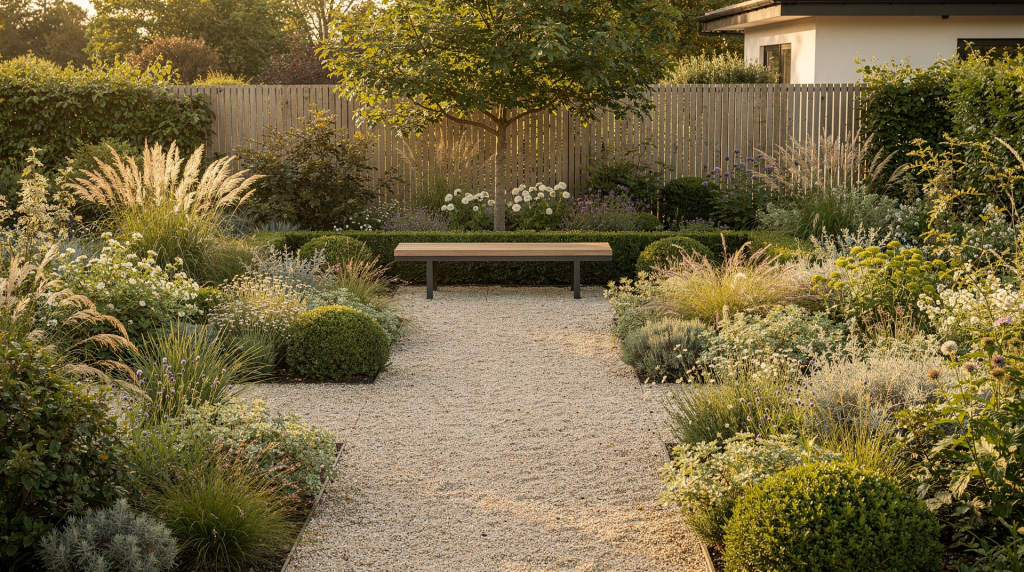
When I walk through a private garden that truly works, the planting rarely announces itself. It feels inevitable — as though the plants arrived not by choice but by some quiet logic of the place. That logic is what I call planting philosophy, and in the best contemporary schemes it operates less like decoration and more like architecture. The plants hold space, define movement, frame views, and soften hard edges without ever feeling applied. They belong to the soil, the light, and the daily rhythms of the people who live there.
A coherent planting philosophy gives a garden four things that matter deeply over time: winter legibility, movement in wind, summer generosity, and the resilience to absorb whatever the weather brings. Achieving that means starting with the site — its drainage, its microclimates, its awkward corners — and only then composing with repetition, rhythm, and deliberate restraint. The gardens I return to photograph, season after season, are the ones where someone made those decisions early and stuck to them.
What “planting philosophy” really means
Planting philosophy is the quiet framework behind every plant choice, every layout decision, and every maintenance habit. It answers questions that are deceptively simple but structurally decisive:
- Should the garden feel formal or relaxed — and does that answer match the architecture?
- Is the planting meant to frame the house or soften it, to draw the eye outward or hold it close?
- Do you want bold seasonal effects or quiet year-round structure — and can you have both?
- How much time can you realistically give to care and editing, week by week, season by season?
- Should the scheme support biodiversity, drought tolerance, or privacy — and in what order of priority?
In contemporary private gardens, the most durable philosophies balance design clarity with ecological sense. The result is not simply “modern-looking” planting — a label that often masks shallow thinking — but planting that belongs to the house, the climate, and the people using it. I have seen meticulously clipped evergreens look utterly contemporary beside a rendered wall, and loose meadow planting feel perfectly at home against a timber barn. The common thread is always the same: the plants answer the site, not the other way round.
The core principles of contemporary planting
1. Right plant, right place
This remains the rule that no amount of design talent can override. A plant may look beautiful in a monograph or on a nursery bench, but if the soil, light, wind exposure, or moisture levels are wrong, it will spend its life struggling — and the garden will feel unsettled. I have learned to read a site before I even look at a plant list.
Check:
- Soil type: clay, loam, sand, or chalk — dig a test hole and feel the texture
- Drainage: does water sit after rain, and for how long?
- Aspect: full sun, part shade, or deep shade — and how that shifts through the year
- Exposure: sheltered, windy, coastal, or frost-prone — each demands a different palette
- Maintenance: can the planting be cut back, fed, or watered regularly, or does it need to fend for itself?
A contemporary garden succeeds when plant choices feel inevitable, not forced. That sense of rightness comes from matching species to conditions so precisely that the garden looks as though it grew there by itself.
2. Structure before decoration
In many private gardens, planting fails because it is added before the bones of the garden are clear — a flurry of perennials and ornamental flowers laid over unresolved space. Contemporary schemes need a visible framework that holds the garden together when everything else fades.
That framework usually comes from:
- Evergreens — not as dull blocks, but as sculptural anchors
- Repeated shrubs — the same plant appearing in several places to tie the composition together
- Grasses — for movement and winter presence
- Small trees — to create canopy and vertical layering
- Strong edged beds — clean lines that read clearly from the house
- Clean lawn or gravel lines — negative space that gives the planting room to breathe
These elements hold the design in winter and stop the garden from feeling visually empty when flowers fade. I often advise clients to imagine their garden in January first, and only then think about June.
3. Repetition creates calm
One of the most useful ideas in contemporary planting — and one of the hardest for plant-loving gardeners to accept — is restraint. Instead of filling a border with many different plants, repeat fewer species in larger sweeps. This is a lesson I learned from studying land art and large-scale landscape projects, where repetition builds rhythm across vast spaces. In a private garden, the same principle works at intimate scale.
This does three things:
- Makes the garden easier to read — the eye moves smoothly rather than jumping
- Strengthens the visual rhythm — repetition creates a pulse
- Reduces a messy, over-collected look — the garden feels curated, not cluttered
Repetition is especially effective in smaller gardens, where too much variety can make a space feel crowded and restless. A single grass repeated along a path, or three identical shrubs placed at intervals, can transform a fragmented border into a composed one.
4. Texture matters more than colour alone
Colour is often the first thing people notice, but texture gives a contemporary garden its depth and its staying power. Fine grasses next to broad leaves. Matte foliage beside glossy evergreen. Upright spires against low mounds. These relationships work long after flowers have finished, and they photograph beautifully in flat winter light.
A strong scheme usually mixes:
- Bold leaf shape — hostas, rodgersia, or architectural ferns
- Soft movement — stipa, deschampsia, or molinia catching the breeze
- Seasonal contrast — seedheads, fading foliage, bark
- A limited colour palette — two or three tones that repeat rather than compete
This creates subtlety, which is often more powerful than constant bright flowering. The gardens I remember most clearly are the ones where texture carried the composition, and colour was a seasonal gift rather than the whole story.
5. Seasonal interest must be planned, not accidental
A private garden should work across the year, not only in June. Contemporary planting is strongest when each season has a role, and when those roles are designed in from the start rather than hoped for.
- Spring: fresh growth, bulbs pushing through, emerging structure — the garden waking up
- Summer: fullness, movement, flowering, layered foliage — the garden at its most generous
- Autumn: seedheads, fading colour, grasses turning gold, late perennials holding form
- Winter: evergreen mass, bark, stems, architectural silhouette — the garden stripped back to its bones
If a garden looks good only in one month, the planting philosophy is too narrow. I test every scheme by asking: what does this look like on a grey February morning? If the answer is uncertain, the structure needs strengthening.
Common planting styles in contemporary private gardens
| Planting style | Character | Best for | Main advantage | Main limitation |
|---|---|---|---|---|
| Naturalistic | Loose, layered, drifted planting | Larger gardens, informal settings | Ecological value and movement | Can look untidy if not edited well |
| Structural modern | Strong shapes, repetition, clear lines | Courtyards, terraces, new-build homes | Clean, calm visual order | Can feel sparse without texture |
| Mediterranean-inspired | Silver foliage, drought tolerance, sun-loving plants | South-facing gardens, dry sites | Heat tolerance and low water use | Struggles in heavy shade or wet soil |
| Woodland-inspired | Shade-tolerant layering and spring effect | Mature plots, tree cover | Suits sheltered, private spaces | Needs careful control to avoid heaviness |
| Mixed contemporary | Structured framework with softer underplanting | Most private gardens | Flexible and practical | Requires clear editing to avoid confusion |
The best choice depends on the architecture and the site, not on trend. I have seen structural modern planting look cold against a warm brick house, and naturalistic planting feel chaotic beside sharp contemporary architecture. The style must answer the building and the land, not a magazine spread.
How to build a planting scheme that works
Step 1: Read the site properly
Before choosing plants, study the site with patience. Walk it at different times of day. Stand where the kitchen window looks out, where the terrace catches evening sun, where children or dogs cut corners. These observations are worth more than any plant catalogue.
Study:
- Sun movement through the day — where does light fall in early morning, at noon, in late afternoon?
- Wet and dry areas — where does water collect, and where does the soil crack in August?
- Views from inside the house — what do you see from the sofa, the dining table, the bedroom window?
- Key sightlines from terrace, kitchen, and main windows — what draws the eye, and what needs screening?
- Places where people gather, pass through, or sit — these are the moments planting must serve
This is where many schemes fail. Planting should improve how the garden feels from both outside and indoors. A border that looks beautiful from the lawn but invisible from the house is only doing half its job.
Step 2: Define the job of each area
Different parts of the garden need different planting logic. Treating the whole site with one uniform approach flattens the experience and misses opportunities for contrast and intimacy.
- Entrance areas need clarity and welcome — planting that guides, not obstructs
- Terrace edges need softness without blocking movement — plants that brush against you, not trip you
- Boundary planting needs screening and depth — layers that create privacy without feeling like a fortress
- Feature beds can carry more visual drama — moments of intensity viewed from key positions
- Quiet corners can be looser and more atmospheric — places for discovery, not display
A single planting style across the whole garden often feels flat. The most memorable private gardens I have documented use shifts in planting character to define different moods and functions, all held together by a consistent underlying palette.
Step 3: Choose a base palette
Start with a small number of plants that do the heavy lifting — the reliable performers that will carry the garden through the year. These are not necessarily the most exciting plants, but they are the ones you will never regret planting.
These usually include:
- 2–3 structural shrubs — evergreens or woody plants that hold form in winter
- 1–2 grasses — for movement, light, and seasonal transformation
- 2–4 perennials for seasonal change — plants that peak at different moments
- 1–2 evergreen anchors — solid presences that never disappear
- Bulbs or annuals for short-term lift — moments of delight that come and go
Keep the palette limited enough that the scheme feels coherent. Add variety through scale, texture, and season, not endless species. A garden with twelve well-chosen plants repeated thoughtfully will almost always look more confident than one with sixty plants jostling for attention.
Step 4: Layer the planting
Good contemporary planting is layered vertically as well as visually. A flat, single-level border reads as a strip, not a space. Building upward creates depth, habitat, and a sense of immersion.
Think in three levels:
- Canopy: small trees or taller shrubs — the ceiling of the garden
- Middle layer: shrubs and perennials — the body of the planting
- Ground layer: low perennials, bulbs, or mulch — the floor that ties everything together
This prevents the garden from looking flat. It also helps the planting perform as a living system rather than as a collection of isolated specimens. When I photograph gardens with strong layering, the images have a sense of depth and enclosure that single-layer planting rarely achieves.
Step 5: Edit for maturity
A common mistake is designing for the day of planting, not the garden in three years. Spacing matters profoundly. Plants need enough room to develop without collapsing into each other too early, and the gardener needs access for maintenance without trampling emerging growth.
Ask:
- Will this still feel balanced when the shrubs mature?
- Will taller plants block views that matter?
- Is there enough air movement to reduce disease?
- Will maintenance access still be possible when everything fills out?
If the answer is unclear, simplify the scheme. I have watched too many gardens become overcrowded and airless within five years because the initial planting was too dense and too optimistic. Leaving space is not emptiness — it is an investment in the garden’s future.
Practical planting combinations that suit contemporary gardens
For a clean, architectural look
Use upright evergreens — yew, Portuguese laurel, or fastigiate hornbeam — as vertical punctuation. Repeat ornamental grasses like Calamagrostis ‘Karl Foerster’ or Panicum ‘Northwind’ in rhythmic groups. Choose perennials with strong form: Echinacea, Eryngium, or Sedum ‘Matrona’. Keep the colour range restrained — whites, silvers, deep greens, and the occasional hit of burgundy.
Works well with: rendered walls, timber cladding, minimal paving, rectilinear beds. The planting echoes the architecture’s clarity rather than fighting it.
For a softer contemporary feel
Use loose grasses — Stipa tenuissima, Molinia, or Deschampsia — to blur edges and catch light. Add rounded shrubs like Pittosporum ‘Tom Thumb’ or Hebe for solidity without stiffness. Choose long-flowering perennials: Geranium ‘Rozanne’, Nepeta, or Salvia. Scatter seasonal bulbs — alliums, camassias, or narcissus — for spring lift. Allow controlled self-seeding in small amounts, but edit ruthlessly.
Works well with: family gardens, countryside houses, spaces that need a relaxed tone. The planting feels generous and lived-in without losing composure.
For a dry, sunny garden
Use drought-tolerant shrubs — Cistus, Teucrium, or Santolina — that thrive on neglect. Plant Mediterranean herbs: rosemary, lavender, thyme, and oregano, both for scent and structure. Lean into silver foliage: Artemisia, Convolvulus cneorum, or Stachys byzantina. Use gravel mulches to reflect heat and suppress weeds. Choose deep-rooted perennials like Euphorbia or Achillea that reach down for moisture.
Works well with: south-facing terraces, exposed plots, gravel gardens. The planting feels appropriate to the climate rather than fighting it with irrigation.
For a shady private garden
Use ferns — Dryopteris, Polystichum, or Asplenium — for texture and prehistoric presence. Build evergreen structure with Sarcococca, Fatsia, or Mahonia. Choose shade-tolerant perennials: Helleborus, Epimedium, or Tiarella. Plant spring bulbs — snowdrops, bluebells, or erythroniums — to catch the light before the canopy closes. Focus on leaves with strong texture and contrast: glossy against matt, divided against entire.
Works well with: woodland edges, enclosed gardens, north-facing courtyards. The planting feels cool, calm, and deeply private.
Soil, water, and maintenance: the part people forget
Beautiful planting is only sustainable if it can be maintained properly. I have seen exquisite schemes collapse within two years because the maintenance reality did not match the design ambition. This is not a failure of gardening skill — it is a failure of philosophy.
Soil improvement
Healthy soil supports healthier roots, better moisture retention, and stronger growth. In most private gardens, adding organic matter — compost, leaf mould, well-rotted manure — is more useful than chasing exotic plants. Feed the soil, and the plants will follow.
Water strategy
New planting needs regular watering during establishment, especially in the first season. After that, a scheme should be watered deeply and less often rather than with frequent shallow spraying. Deep watering encourages roots to grow downward, building resilience. Shallow watering keeps roots near the surface, vulnerable and dependent.
Mulching
Mulch reduces evaporation, protects soil life, and suppresses weeds. In contemporary gardens, it also helps the scheme look finished — a clean, dark surface against which foliage and form read clearly. Gravel, bark, or composted mulch each suit different aesthetics and conditions.
Maintenance realism
Choose a style that matches available care. Be honest about time, energy, and skill.
- Low-maintenance does not mean no-maintenance — even gravel gardens need editing
- Naturalistic planting needs editing — dead stems, over-enthusiastic spreaders, seasonal cut-back
- Formal planting needs clipping and definition — hedges, topiary, crisp edges
- Mixed schemes need seasonal review — what worked last year may need adjusting this year
The right philosophy is the one the owner can actually sustain. A simple scheme maintained beautifully will always outshine an ambitious scheme left to unravel.
Typical mistakes in contemporary planting
- Using too many species and losing visual clarity — the garden becomes a catalogue, not a composition
- Ignoring soil and drainage — planting into compacted clay or waterlogged ground without preparation
- Planting for instant fullness without future space — a common error in show gardens and new builds
- Choosing “modern” plants that are not suited to the site — architectural form cannot compensate for wrong conditions
- Forgetting winter structure — the garden disappears for five months of the year
- Overusing hard contrast without softness — too much sharpness becomes exhausting
- Designing only for photos, not daily use — the garden looks good from one angle but fails as a lived space
- Treating planting as an afterthought to paving and walls — plants arrive last, when budgets and energy are spent
These mistakes are common because planting is often seen as the finishing touch. In reality, it is one of the main forces shaping the whole garden. When I consult on a project where hard landscaping has already been installed, I know the planting will have to work harder to compensate for decisions made without it.
A simple checklist for reviewing a planting concept
- Does the planting suit the soil and aspect?
- Is there a clear structural framework?
- Are plants repeated enough to create rhythm?
- Is there interest in all four seasons?
- Does the scheme match the house style?
- Can the planting be maintained realistically?
- Does it look good from inside the home?
- Does it support privacy, shade, softness, or biodiversity where needed?
If several answers are weak, the scheme needs refinement before planting begins. This checklist is not bureaucratic — it is a way of testing whether the philosophy holds together under scrutiny. I use it on every project, and it rarely lets me down.
Choosing a philosophy for your own garden
The best planting philosophy depends on what the garden needs most — and that answer is different for every site and every household.
- Choose structural planting if the house is strong and architectural — the garden should match its confidence
- Choose naturalistic planting if you want movement and softness — a garden that breathes and shifts
- Choose dry-garden planting if the site is hot, exposed, or free-draining — work with the climate, not against it
- Choose woodland planting if the garden is shaded and sheltered — embrace the cool, quiet atmosphere
- Choose mixed contemporary planting if you want flexibility and year-round depth — structured bones with a softer skin
There is no single correct style. The right answer is the one that creates a garden with character, clarity, and ease of care — a garden that feels like it belongs to the people who live there, not to a designer’s portfolio.
FAQ
What makes contemporary planting different from traditional planting?
Contemporary planting usually uses stronger structure, more repetition, and a more restrained palette. Traditional planting often relies on denser seasonal display and a looser mix of species. The difference is not about which plants are used, but how they are arranged and edited.
Do contemporary gardens have to be minimal?
No. They can be lush, layered, and colourful. The difference is usually in how the plants are arranged: more order, clearer structure, and stronger editing. A contemporary garden can be abundant without being chaotic.
Is naturalistic planting suitable for private gardens?
Yes, especially in larger or softer landscapes. It works best when it is carefully designed and regularly maintained so it does not become unruly. Naturalistic does not mean unmanaged — it means managed with a light but knowing hand.
How many plant varieties should a contemporary garden use?
There is no fixed number, but fewer is usually better. A limited palette repeated well almost always looks more confident than a crowded mix. Start with twelve to fifteen core plants and build from there only if the scheme demands it.
What is the biggest planting mistake in a new garden?
Planting without enough attention to site conditions. Soil, light, drainage, and future growth should shape every decision. No amount of design talent can rescue a plant placed in the wrong spot.
Conclusion
A strong planting philosophy for contemporary private gardens is not about chasing trends or replicating images from magazines. It is about making deliberate choices that suit the home, the site, and the way the garden will be used over time — by real people, in real weather, through real seasons. When planting is grounded in structure, repetition, seasonal depth, and practical care, the result feels calm, timeless, and fully lived in.
The most successful gardens I have documented do not try to do everything. They do the right things well. They know what they are, and they are comfortable in that knowledge. That confidence — quiet, unshowy, deeply rooted — is what makes a garden worth returning to, year after year.