Landscape Design Principles Inspired by the Garden of Cosmic Speculation
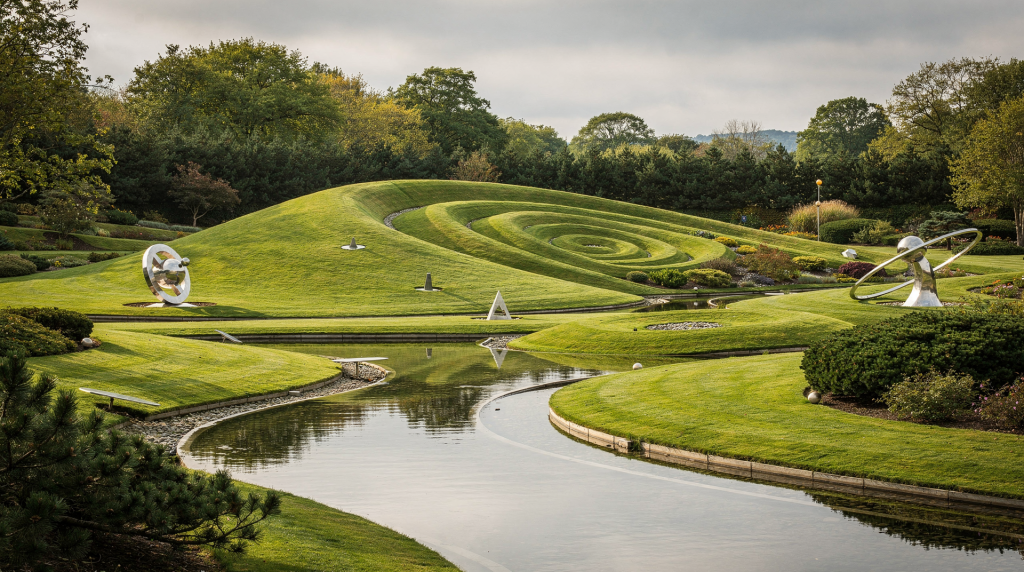
The first time I walked through the Garden of Cosmic Speculation, what struck me wasn’t the visual drama—though there’s plenty of that—but the quiet confidence of its structure. Here is a landscape that refuses to be merely decorative. Every landform, every terrace, every curve in the path serves an idea. The garden doesn’t try to charm you with flowers; it asks you to move through it, to feel the ground change underfoot, to notice how one space gives way to another. For anyone designing a private garden, this is the real gift: not a catalogue of sculptural forms to copy, but a way of thinking about landscape as something that shapes experience from the ground up.
What the Garden of Cosmic Speculation teaches designers
Set in the rolling hills of Dumfriesshire, this garden has been evolving for decades as an experimental landscape—part artwork, part laboratory of spatial ideas. Across its forty major areas, you’ll find terraces that reference mathematical sequences, water features that play with reflection and sound, bridges that mark thresholds between distinct moods, and landforms that turn abstract scientific concepts into something you can walk through. It’s not a pretty garden in any conventional sense. It’s a designed landscape with intellectual backbone.
For residential work, this matters more than most people realize. A garden becomes stronger—more livable, more memorable—when it’s conceived as something beyond planting beds arranged around a house. The best private gardens I’ve documented share five qualities with this place: a clear organizing idea that you can sense even in winter; routes that make you want to explore; defined spaces with distinct atmospheres; a visible dialogue with the architecture; and a sense of time unfolding, not just instant impact.
1. Start with a concept, not with plants
I’ve seen too many gardens begin with a shopping list of plants and end up as collections rather than compositions. The Garden of Cosmic Speculation takes the opposite approach. Its forms and sequences are tied to themes—space, time, geometry, the natural world—and everything else follows. For a private garden, the concept doesn’t need to be abstract or theoretical. It can be as simple as a garden built around outdoor entertaining, or a quiet retreat for reading and reflection, or a family garden with clearly separated zones for play and dining, or a rural garden designed to frame views and mark the passing seasons.
The point is to let the design language emerge from purpose, not from a catalogue.
How to apply this at home
Before you draw a single line, sit with three questions. First: how should the garden feel in everyday use—not on special occasions, but on an ordinary Tuesday morning? Second: where do people actually move, stop, gather, and look? Trace the natural desire lines before you impose new ones. Third: what should the garden emphasize? Views, enclosure, drama, calm, or planting? A garden that tries to do everything usually achieves nothing in particular. Answer these honestly, and they’ll guide everything from levels and paths to paving choices and planting density.
2. Use landform to shape experience
The sculptural landforms at the Garden of Cosmic Speculation create a sense of movement and surprise that stays with you long after you leave. In a residential setting, you don’t need dramatic earthworks to achieve something similar. Even subtle changes in level—a raised lawn that improves drainage while adding presence, a shallow dip that creates an enclosed seating area, a berm that screens a neighboring building—can transform how a garden feels.
Other techniques worth considering: terraced slopes that make a difficult site usable without erasing its character, and stepped transitions between house and garden that turn a threshold into an experience.
Why this works
People experience a garden through the body, not just the eyes. A slight rise underfoot can make a space feel ceremonial. A lowered area, even by just a few inches, can feel private and protected. A terrace carved into a slope makes the site usable while preserving its natural drama. These aren’t abstract design theories—they’re physical realities that anyone can feel.
Common mistake
Many gardens flatten everything for convenience. The result is often practical but forgettable—a smooth green carpet with no story to tell. Gentle variation is usually enough to add identity without making maintenance difficult. A twelve-inch change in grade can do more for a garden’s character than an expensive sculpture.
3. Design movement as a sequence
What makes the Garden of Cosmic Speculation so memorable is that it’s discovered in stages. You never see everything at once. You move through it, and each area has its own mood, its own geometry, its own relationship to light and enclosure. This is a powerful model for domestic gardens, where the temptation is often to lay everything out in one open expanse.
Think in sequences: arrival, transition, main outdoor room, quieter secondary space, a concealed or seasonal area, a viewpoint or end feature. Each should feel like a deliberate chapter, not an afterthought.
Practical way to plan routes
Use paths not just to connect points, but to control pace. A direct path is efficient—good for utility routes. A curved path slows the body and builds expectation. Even a short route can feel rich if it passes one edge, one change of texture, and one focal point along the way. A good garden route should answer three things: where am I coming from, what am I meant to notice, and where does this route end? If you can’t answer those, the path is just pavement.
4. Treat geometry as a design tool, not a style
Bold geometry runs through the Garden of Cosmic Speculation—curves, spirals, waves, terraces, repeated forms that echo across different areas. In domestic landscape design, geometry isn’t about imposing a style; it’s about bringing order to a large site or clarity to a small one. Circles work beautifully for seating courts or fire areas. Long rectangles give terraces and dining spaces a sense of purpose. Repeated arcs can soften formal boundaries without losing structure. Diagonal paths create energy on a grid site. Mirrored beds or walls bring balance near the house.
When geometry helps most
Geometry shines around contemporary architecture, on exposed sites that need visual structure, where the house has strong lines and clean elevations, and in gardens that need to feel intentional in winter when planting recedes. In these conditions, geometric forms act as the garden’s skeleton—visible, readable, reassuring.
When to soften it
If the house is very traditional or the plot is highly naturalistic, geometry works best in moderation. Use it in the main structure—the terrace, the primary axis, the boundary walls—then loosen it in planting. Let perennials spill over edges. Let grasses blur the lines. The geometry remains as an undercurrent, not a straitjacket.
5. Balance sculpture and planting
The Garden of Cosmic Speculation is not a planting-led garden in the classic ornamental sense, and that’s part of its power. Planting supports the composition rather than competing with it. For private gardens, this suggests an important principle: not every area needs dense planting. Sometimes the most effective landscape includes open lawn or meadow, architectural hedging, clipped shapes, groundcover for continuity, selective structural trees, and restrained seasonal planting that punctuates rather than overwhelms.
A good planting strategy
I think of planting in three layers. First, structure: trees, hedges, and larger shrubs that define the garden’s bones and remain visible year-round. Second, the middle layer: perennials, grasses, and seasonal drifts that add movement and color. Third, detail: bulbs, low texture plants, and focal accents that reward close attention. This keeps the garden readable in all seasons and prevents the visual clutter that comes from trying to fill every square foot.
Typical error
Overplanting too early can hide the structure of the design. I’ve watched gardens disappear under a tide of enthusiastic planting within three years. If the bones of the garden are weak—if the paths, levels, and spatial divisions aren’t clear—no amount of flowers will fix it. Build the framework first, then dress it.
6. Use water for reflection, not decoration
Water in the Garden of Cosmic Speculation is part of the spatial story. It’s not ornamental in the way a fountain might be; it changes how you experience a place. In residential design, water is most effective when it serves a purpose beyond looking pretty. A still basin can reflect architecture and sky, doubling the perceived space. A narrow rill can guide movement through a sequence of rooms. A pond can collect views and wildlife. Stepped water can create sound and rhythm that masks traffic noise. Even a drainage feature can be disguised as a design element—a dry streambed that comes alive in rain.
What to check before adding water
Be honest about maintenance. Can it be kept clean easily? Will it freeze, leak, or collect debris? Does it have a purpose beyond visual effect? Is it visible from the house, where you’ll actually experience it daily? Small, well-placed water elements often work better than large ones that become expensive burdens. A simple reflecting basin outside a living room window can do more than an elaborate pond hidden at the bottom of the garden.
7. Make thresholds meaningful
One of the strengths of the Garden of Cosmic Speculation is the way it turns movement into an experience. Transitions matter: terrace to lawn, path to bridge, open area to enclosed room. In residential gardens, thresholds are where design becomes memorable. They can be created by a change in material—gravel giving way to stone, timber deck to lawn. A step up or down. A gate or screen that partially conceals what lies beyond. A narrow passage opening into a wider room. A shift from hardscape to planting.
Why thresholds matter
They create a feeling of arrival. Without them, the garden can seem continuous but bland—one space bleeding into the next with no punctuation. With them, every space gets a clear identity. You feel yourself crossing from one world into another, even if the distance is only a few steps.
Design principles compared
| Principle | What it means | How to use it at home |
|---|---|---|
| Concept-led design | The garden starts with an idea | Define the function and mood before choosing materials |
| Landform | Shape the ground to shape use | Add terraces, mounds, or subtle levels |
| Sequence | Spaces are revealed gradually | Plan routes with pauses and focal points |
| Geometry | Form creates order and rhythm | Use circles, grids, arcs, or diagonals intentionally |
| Restraint in planting | Planting supports structure | Build a clear framework before filling in |
| Water as an experience | Water changes mood and movement | Use reflection, sound, or a rill with purpose |
| Thresholds | Transitions define spaces | Mark entrances, steps, and material changes |
A practical process for designing a garden inspired by this approach
Step 1: Map the site honestly
Record sun, wind, views, privacy issues, slope, and existing trees. Don’t design around assumptions. Spend time on site at different hours and in different weather. The way light falls across a potential seating area in late afternoon might change everything.
Step 2: Define the main outdoor rooms
Most successful gardens have at least three functions: an arrival or front edge that sets the tone, a living and dining space that works for daily use, and a quiet retreat or secondary use area that offers something different. These don’t need to be large, but they need to feel distinct.
Step 3: Choose one strong organizing move
This might be a central axis, a curved route, a terrace, a water feature, or a formal lawn. Don’t use everything at once. A garden with one clear idea reads as intentional; a garden with five competing ideas reads as confused.
Step 4: Add one memorable transformation
A change in level, a framed view, a hidden seat, or a sculptural element can give the garden character. This is the moment that stays with people—the thing they’ll mention when they describe your garden to someone else.
Step 5: Build the structure first
Hardscape, levels, boundaries, and trees come before detailed planting. These are the elements that will still be there in twenty years. Get them right, and the planting can evolve around them.
Step 6: Refine the planting
Choose plants that support the geometry and the atmosphere rather than overpowering them. This is where restraint pays off. A few well-chosen species in generous drifts often feel more considered than a botanical collection.
Checklist for a Garden of Cosmic Speculation-inspired design
- Does the garden have a clear concept?
- Is there a strong route through it?
- Are there spaces that feel distinct from one another?
- Does the landform improve how the garden is used?
- Is the planting supporting the architecture of the site?
- Are there transitions that create drama or calm?
- Does one area give a memorable final impression?
- Can the garden be understood in winter as well as summer?
Mistakes to avoid
- Copying sculptural forms without understanding the underlying structure
- Using too many features in one small garden
- Letting planting hide the layout
- Ignoring maintenance from the start
- Designing a beautiful image instead of a usable space
- Making every area equally important
A garden with too many focal points has no focal point at all. The eye needs somewhere to rest, and the body needs a clear hierarchy of spaces to navigate.
When this approach works best
These principles are especially effective for country houses with generous land, contemporary homes that need stronger landscape framing, sloping sites, gardens that need year-round structure, and properties where outdoor living is central to how the house is used. They can also work in smaller gardens, but the scale must be adjusted. On compact plots, the best results usually come from one strong idea, one clear route, and restrained detailing. A tiny courtyard with a single water basin, one sculptural tree, and a carefully considered threshold can feel more expansive than a larger garden with no focus.
Conclusion
The Garden of Cosmic Speculation shows that landscape design becomes powerful when it combines idea, structure, and experience. For private gardens, the takeaway is not to imitate its visual language directly—you don’t need spiraling landforms or mathematical terraces—but to borrow its discipline. Build a clear concept. Shape the ground with intention. Guide movement through sequences that reward exploration. Let planting reinforce the whole rather than compete for attention.
That approach creates gardens that feel considered, distinctive, and quietly memorable. More importantly, it creates outdoor spaces that work as part of the home, not as decoration around it. A garden designed this way doesn’t just look good in photographs; it feels right to live in, season after season.
FAQ
What is the main design lesson from the Garden of Cosmic Speculation?
The main lesson is that a garden should be designed as a sequence of spaces with a clear idea behind it, not as a collection of isolated features. Structure comes first, and everything else—planting, ornament, detail—supports that structure.
Can these principles work in a small garden?
Yes. The scale must be simplified, but the same ideas still apply: a clear concept, strong structure, defined movement, and careful use of planting. A small garden benefits even more from restraint and clarity because there’s less room for error.
Do I need dramatic landforms to use this style?
No. Even subtle changes in level, paving, planting height, or enclosure can create the same sense of rhythm and discovery. A six-inch step can define a threshold as effectively as a six-foot berm.
Is this approach formal or naturalistic?
It sits between the two. The structure is deliberate and geometric, while planting can be softened to suit the house and site. Think of it as a strong skeleton with a looser, more natural skin.
What is the biggest mistake to avoid?
The biggest mistake is copying the look without understanding the logic. The strength of this approach lies in how the whole landscape is organized—the relationship between concept, landform, movement, and planting. Without that underlying logic, the forms become empty gestures.