How Photography Changes the Experience of Experimental Gardens
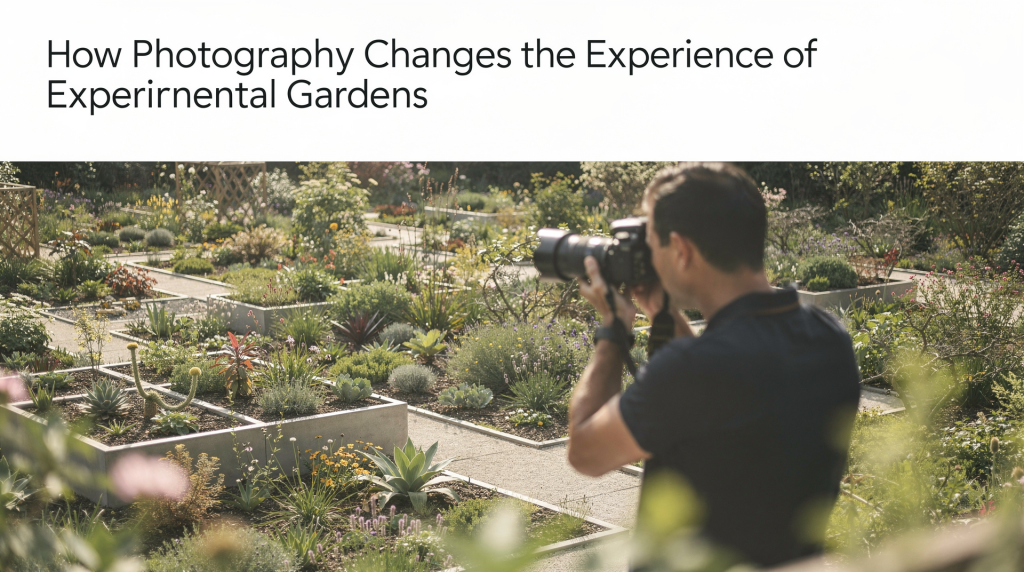
Experimental gardens are built to be explored slowly—step by step, turn by turn—but photography changes that experience in a powerful way. It can sharpen attention, reveal structure, and make fleeting details feel legible; it can also flatten atmosphere if the images ignore movement, scale, and context.
In other words, photography does not just record an experimental garden. It actively interprets it. Every frame is a decision about what matters and what can be left unseen.
Why experimental gardens feel different through a camera
Experimental gardens often depend on surprise, spatial rhythm, and a sequence of views rather than a single “best” composition. They unfold around you, withholding and revealing in turns. Eye-tracking and visual-perception research on garden landscapes confirms what designers have long suspected: spatial composition directly affects where people look and how they understand coherence, mystery, and legibility in a space. When you raise a camera, that relationship intensifies—you stop being a passive wanderer and start reading the garden as a set of deliberate choices.
In practice, a photograph can either clarify the garden’s ideas or reduce them to isolated shapes. The difference lies in whether the photographer understands what the garden is trying to do. A good image changes the way a viewer reads the garden by:
- emphasizing pattern, repetition, and geometry that might otherwise feel incidental
- revealing the relationship between sculpture, planting, and topography—how a landform meets a hedge, how a water channel cuts through gravel
- slowing down attention so small transitions become visible: the shift from shade to dappled light, the moment a path narrows
- turning movement through space into a visual story, where each image implies the next step
This is especially true in gardens influenced by land art, where documentation is part of the work’s meaning. The photograph is not only evidence; it becomes part of how the garden is understood—sometimes the only way people will ever encounter it. In those cases, the image carries an unusual weight: it stands in for the physical experience and must therefore work harder to convey atmosphere, scale, and the sense of being there.
What photography reveals that walking can miss
Walking through an experimental garden is immersive. Your body is in the space; you feel the gradient underfoot, the temperature shift near water, the sound of gravel or grass. Photography is selective. It strips away all that sensory noise and leaves you with a framed view. That selectivity can be useful, because it makes the viewer notice what the eye might otherwise skim past—the precise alignment of a hedge with a window, the way a shadow falls across a step, the repetition of a particular form across the site.
1. Spatial structure
A camera exposes alignment, edges, intervals, and geometry with unusual clarity. Landscape photographers often look for the underlying composition of a space before they frame it—the bones beneath the planting. In experimental gardens, this can reveal the designer’s logic: axial tension that pulls you toward a focal point, repeated modules that create rhythm, or a deliberate clash between natural form and constructed order. What felt like a casual arrangement suddenly reads as a system.
2. Scale
A photograph can make a large landscape feel intimate or make a small garden seem monumental, depending on lens choice and viewpoint. Images taken from ground level—at eye height, as a visitor would actually stand—often communicate how the space feels to inhabit, not just how it appears from above. This is crucial for private gardens, where the experience is bodily and close, not panoramic and detached. A low viewpoint can make a courtyard feel expansive; a carefully chosen wide angle can pull the surrounding countryside into a terrace garden, reminding you that the boundary is permeable.
3. Material contrast
Experimental gardens frequently combine hardscape, planting, water, sculpture, and earthworks. Photography makes contrast visible in ways that walking sometimes smooths over: rough against smooth, reflective against matte, dense against open. A photograph can isolate the moment where rusted steel meets a swath of grasses, or where polished concrete gives way to moss. These material dialogues are often central to the garden’s character, and the camera can make them legible as intentional design moves rather than happy accidents.
4. Seasonal change
A photograph freezes a moment, which is both a limitation and a strength. It helps compare how a garden behaves in different seasons, and it documents how a planting scheme alters the balance of the whole design over time. A border that reads as soft and billowing in June may reveal its structural skeleton in November; a water feature that sparkles in summer may turn dark and reflective in winter. Returning to the same spot across months or years builds a record of the garden as a living, changing thing—something a single visit can never provide.
How photography changes the visitor’s experience
Photography does more than influence publication. It changes how people move through a garden, often without them realizing it. The act of looking for images reshapes the visit itself.
It encourages slower looking
Photographers tend to pause, reconsider, and reframe. That slows the visit down. In a garden built around sequence or discovery, this is a major advantage. The visitor begins to notice transitions between spaces—the compression before a release, the dark passage before a bright clearing—rather than treating the garden as a single scene to be consumed and moved past. You start to read the punctuation: the pauses, the accelerations, the full stops.
It creates a search for composition
Once a person starts looking for a frame, they become more alert to line, balance, and contrast. This can make the garden feel more structured and intentional than it did at first glance. A planting scheme that seemed loose suddenly reveals its grid; a scatter of boulders becomes a deliberate arrangement. The camera trains the eye to see design, not just scenery.
It can distort memory
A strong photograph may replace the lived experience in memory. Visitors often remember the “hero shot” instead of the feeling of turning a corner, hearing water, or passing through shade. That is the trade-off: photography clarifies, but it can also simplify. The image becomes the memory, and the full sensory experience—the wind, the scent of damp earth, the sound of gravel underfoot—fades behind it. This is something to be aware of, not necessarily something to avoid.
It can increase appreciation for design
A well-made image helps non-specialists understand why the garden works. The best images show not just plants, but the design of the space, its relationships, and the sense of movement through it. For a private garden or country house, where the landscape is often an extension of the architecture, a photograph that captures how the building meets the ground—how a terrace steps down into a lawn, how a pergola frames a view—can make the design logic instantly clear to someone who might otherwise just see a pretty garden.
The photographer’s role: interpreter, not neutral observer
In experimental gardens, the photographer is always making choices about what story the place tells. Garden photographers often stress the importance of understanding the garden before photographing it—its atmosphere, its design intent, and its unique character. That matters because experimental gardens are usually less about pretty corners and more about an idea made physical. The planting, the landform, the materials: they are all in service of a concept.
A photographer can emphasize:
- the garden as sculpture—solid forms in space, mass and void
- the garden as sequence—a journey with a beginning, middle, and end
- the garden as refuge—enclosure, shelter, a place apart
- the garden as a dialogue between made form and living material—geometry meeting growth, order meeting entropy
Each choice changes the experience for the viewer. Emphasize sculpture, and the planting recedes into texture; emphasize sequence, and the individual moments become less important than the path between them.
“The best photographs of landscape architecture make you feel like you’re in the space.”
That is the standard to aim for. A good image should not merely describe the garden; it should recreate a believable sense of being there—the weight of the air, the quality of the light, the way the ground rises or falls beneath you.
Practical techniques that preserve the experience
If the goal is to photograph an experimental garden honestly, the image must carry atmosphere as well as structure. A technically perfect shot that feels dead is worse than a slightly imperfect one that breathes.
Use viewpoint deliberately
- Shoot from paths, thresholds, and turning points—the places where a visitor would naturally stop and look.
- Include foreground, middle ground, and background so the image feels spatial, not flat. A sweep of gravel in the foreground, a hedge in the middle distance, a tree beyond: this layering pulls the eye in.
- Use lower viewpoints when you want the visitor’s bodily experience to be part of the frame—shooting from waist height or lower can make the garden feel immersive rather than observed from above.
Photograph the sequence, not only the destination
- Capture entrances, transitions, and pauses—the gate, the gap in the hedge, the bench at the turn.
- Show how one space leads to the next: a path disappearing around a corner, a flight of steps rising into shadow.
- Include partial views and glimpses, not only full reveals. A garden that shows everything at once has no mystery; a photograph that shows everything at once has no depth.
This matters because many experimental gardens are designed as a journey. A single image cannot explain that journey, but a series can—each photograph a step along the route, building a cumulative sense of the place.
Respect context
A garden does not exist in isolation. The surrounding buildings, walls, slopes, and wider landscape often explain why the garden takes its shape. Context is especially important in private gardens and country houses, where architecture and landscape are tightly linked. A photograph that crops out the house may lose the very thing that makes the garden make sense—the axis that runs from the drawing room window, the way the kitchen garden relates to the service wing, the borrowed view of a distant hill that the entire layout was designed to frame.
Work with light, not against it
Light changes the emotional temperature of a garden. Strong side light—early morning or late afternoon—can reveal texture and relief, throwing every leaf and stone into sharp definition. Soft overcast light can clarify structure without harsh contrast, letting the bones of the design show through. Shadow can deepen mystery and reinforce the sense of sequence: a dark passage makes the bright space beyond feel like a reward. The same garden photographed at noon and at dusk tells two entirely different stories.
Common mistakes when photographing experimental gardens
| Mistake | Why it weakens the image | Better approach |
|---|---|---|
| Shooting only the most obvious sculpture or feature | The garden loses its spatial logic and becomes a collection of objects | Show how the feature relates to the whole site—its setting, its approach, its backdrop |
| Flattening the scene with a telephoto lens | Depth and movement disappear; the garden becomes a backdrop | Mix wider views with tighter details to preserve spatial relationships |
| Ignoring context | The garden feels detached from its setting, as if it could be anywhere | Include buildings, edges, and terrain where relevant—show what anchors the garden to its place |
| Overediting color | Planting and materials stop feeling real; the garden looks like a rendering | Keep tones believable and seasonally accurate—let the place look like itself |
| Photographing only in perfect conditions | The garden’s character becomes one-dimensional; you miss its range | Return in different light and weather—mist, frost, low winter sun—to capture the full spectrum |
A simple workflow for photographing an experimental garden
- Walk the garden once without shooting. Let it work on you. Notice where you pause, where you feel pulled forward, where you feel lost.
- Identify the dominant idea: geometry, sequence, contrast, terrain, or planting rhythm. What is this garden really about?
- Note the best viewpoints for that idea—not necessarily the prettiest views, but the ones that explain the design.
- Photograph the overall composition first, establishing the spatial framework.
- Move to transitions, thresholds, and details—the moments that connect the big moves.
- Capture context: paths, boundaries, and adjacent architecture. Show what the garden belongs to.
- Review whether the images explain the garden’s intent, not just its appearance. If someone who has never visited can read the design logic, you have succeeded.
This workflow prevents the common trap of making attractive but uninformative pictures—images that look good in a portfolio but say nothing about the place.
When photography enhances the garden most
Photography is most effective when the garden has one or more of these qualities:
- strong spatial design—clear axes, defined rooms, deliberate proportions
- repeated forms or patterns—a rhythm of columns, a recurring curve, a modular grid
- sculptural planting—masses and voids, bold textures, plants used as architectural elements
- earthworks or topographic change—mounds, terraces, sunken areas, landform as structure
- a clear relationship between house and landscape—the garden as an extension of the architecture
- a sense of progression through time or space—a journey, a narrative, a sequence of experiences
These are exactly the qualities that often define experimental gardens. The camera helps separate and articulate them, making visible what the body feels but the mind may not consciously register.
When photography can mislead
Photography becomes misleading when it presents the garden as static decoration. Experimental gardens are often about change: wind, weather, seasonal growth, shifting light, and movement through space. A still image can never fully capture that. It can only suggest it—through the blur of grasses in a breeze, the quality of light that implies a time of day, the composition that implies a path you want to follow.
That is why the strongest garden photography combines precision with restraint. It shows enough to explain the design, but leaves room for the viewer to imagine standing there—to feel the air, to hear the water, to sense what lies just outside the frame. An image that explains everything leaves nothing for the imagination to do.
Checklist: what a strong experimental-garden image should do
- show the garden’s main idea clearly, not just its prettiest angle
- preserve depth and scale—the viewer should sense how big the space is and how it feels to occupy it
- include context, not just a fragment—the house, the boundary, the borrowed landscape
- suggest movement through the space—a path, a gap, an invitation to step further in
- balance structure with atmosphere—the bones and the breath of the garden
- feel truthful to the season and light—honest about the moment it was made
- make the viewer want to enter the garden, not just admire it from a distance
FAQ
Does photography change how people judge a garden?
Yes. It often makes the design more legible—the structure becomes clearer, the relationships more obvious. But it can also make the garden seem tidier or more fixed than it feels in person. A photograph freezes a living system; the real garden is always in motion, always slightly unfinished.
Should experimental gardens be photographed like ordinary gardens?
No. They usually need more attention to sequence, structure, and context than decorative planting gardens do. An ordinary garden photograph might focus on a beautiful border; an experimental garden photograph needs to explain an idea. The approach must match the ambition of the design.
What is the biggest mistake in garden photography?
Treating the garden as a backdrop instead of a designed space with relationships, transitions, and intent. When the garden becomes just a setting for something else—a house, an event, a product—the photograph stops being about the garden at all.
Why is context so important?
Because many experimental gardens only make sense in relation to the house, site, and broader landscape. Remove the context, and you remove the logic. A sunken garden without its surrounding walls, a borrowed view without the gap that frames it, a terrace without the house it extends—these are incomplete stories.
Conclusion
Photography changes the experience of experimental gardens by translating movement, scale, and atmosphere into a readable visual narrative. When it is done well, it deepens understanding and helps viewers see the design logic behind the beauty—the why beneath the what. When it is done poorly, it reduces a complex landscape to a handful of isolated scenes, each one pretty but mute.
The best garden photographs do not replace the visit. They prepare the eye for it. They teach you how to look, so that when you finally stand in the garden yourself, you see more than you would have seen alone.