A Visual Guide to the DNA Garden, Quark Walk, and Universe Cascade
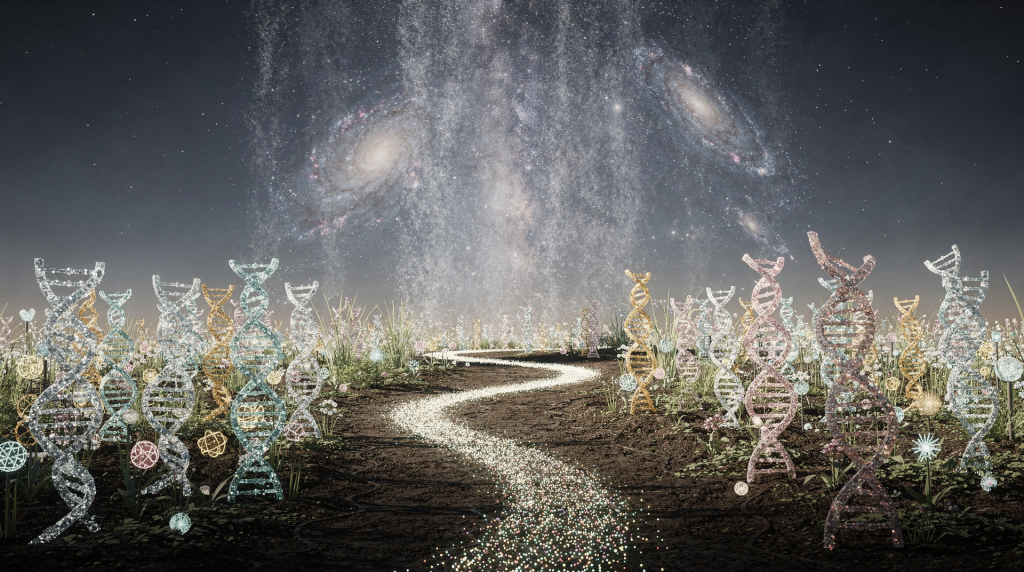
The Garden of Cosmic Speculation is dense with ideas, but three areas consistently do the heaviest interpretive work: the DNA Garden, the Quark Walk, and the Universe Cascade. Together they transform abstract science into a walkable landscape, using planting, stairs, walls, and water to make complex themes feel immediate and legible. For anyone planning a visit, studying the garden, or simply trying to understand how its best-known features operate, these three elements offer the clearest entry point. They also demonstrate how landscape design can function as a visual language rather than mere decoration—a principle Charles Jencks pushed further than almost anyone else. Though conceived on a grand scale, each of these spaces holds lessons for smaller, private gardens: how a kitchen garden can become a sensory diagram, how a narrow path can carry a particle-like rhythm, and how a slope can be turned into a narrative staircase.
Why these three features matter
The garden reads like a three-dimensional essay. Its twenty or so areas are not static exhibits but chapters in a walkable argument about the universe. The DNA Garden, Quark Walk, and Universe Cascade are the most legible chapters because they translate vast concepts—genetics, particle physics, cosmic history—into physical sequences that engage the body as much as the eye. This is the garden’s real innovation: it insists that understanding comes through movement. You don’t stand back and admire; you enter, walk, pause, and descend. The design principle is clear: meaning unfolds in time and space, not in isolated objects.
Quick guide to the three features
| Feature | Main idea | Visual language | What to notice |
|---|---|---|---|
| DNA Garden | Life, senses, and genetic structure | Rectangular cells, box hedging, sculpture, sensory planting | The six compartments and the way planting evokes each sense |
| Quark Walk | Subatomic particles and the structure of matter | Red-painted tree trunks, path, watercourse, mesh and fence effects | The rhythmic repetition and particle-like patterning |
| Universe Cascade | The history of the cosmos | White concrete stair/cascade, water, stepped descent | The journey through time and the dramatic top-to-bottom progression |
The DNA Garden: a kitchen garden turned into a diagram
Tucked close to Portrack House, the DNA Garden—also known as the Six Senses Garden—takes the familiar form of a walled kitchen garden and rewrites its purpose. Instead of vegetables and herbs arranged for the table, you find a diagram of perception. The space is a rectangle divided into six cells by low box hedging and gravel paths. Each cell corresponds to one of the five senses, with the sixth dedicated to intuition. The result is a garden that reads like a code: ordered, geometric, but softened by planting that appeals directly to touch, scent, and sight. The box hedging gives the garden its bones, remaining legible even in winter when the perennials die back. In summer, the cells fill with plants chosen for their sensory qualities—fragrant herbs, rustling grasses, textural foliage. The enclosing walls, typical of a Scottish kitchen garden, create a microclimate and a sense of enclosure that makes the space feel intimate despite its conceptual ambition.
What the layout is doing
At first glance, the DNA Garden reads like a diagram—a plan view of a double helix translated into beds and paths. But it never feels sterile. The strict geometry of the six cells provides a clear framework, while the planting and the occasional sculpture introduce softness and unpredictability. This balance is the garden’s central lesson: a rigid structure can feel alive when the planting carries sensory meaning. The double helix is not merely decorative; it stands for the genetic code that underpins life. Yet the garden broadens the idea to include human perception, making the space about both biology and lived experience. In practical terms, you are walking through a model of how we sense the world.
How to read it on site
Begin with the outer frame. The high walls and dense hedging create a calm, cloistered atmosphere—a necessary contrast to the open parkland beyond. Then move through the cells one by one, letting your senses guide you. Ask yourself: What quality is this cell trying to evoke? Is the planting emphasising scent, texture, colour, or movement? How does the sculpture—often a simple, abstract form—shift your reading of the space? The garden’s strength lies in repetition with variation: each compartment has a distinct identity, but the overall composition remains visually coherent. The box hedging acts as a unifying grid, ensuring that the eye never loses the underlying order.
Design takeaway
For designers, the DNA Garden is a masterclass in turning a functional layout into an interpretive one. A divided garden need not feel rigid; it can feel spacious and generous if each section has a clear purpose and a consistent framework. This model works especially well when you want a small garden to feel larger through segmentation, when you’re designing a kitchen or sensory garden that needs to carry a stronger conceptual weight, or when you want planting to do more than simply fill beds. The key is to establish a strong geometric armature—here, the box hedging—and then let the planting within each cell speak with its own voice. The result is a garden that rewards slow, attentive walking.
Common mistake to avoid
The most common mistake in concept gardens is overloading every element with meaning. When everything shouts, nothing is heard. The DNA Garden succeeds because its symbolism is disciplined. The geometry is unambiguous, the planting is contained within the cells, and the central idea—sensory perception—is repeated rather than overexplained. There is restraint in the choice of materials: gravel, box, a few well-placed sculptures. This restraint allows the visitor to engage without feeling lectured.
The Quark Walk: movement, particle patterns, and visual rhythm
Moving away from the enclosure of the DNA Garden, the Quark Walk occupies a linear strip along the north-eastern boundary, beside a narrow watercourse. Its most arresting feature is a sequence of eight tree trunks painted a vivid red. These trunks are not randomly placed; they represent the mixing pattern of quark particles, turning an invisible subatomic dance into a visual rhythm you can walk alongside. The red paint is a bold choice, but it works because the surrounding palette is so restrained—green foliage, dark water, gravel path. The trunks read like notes on a musical staff, spaced to create a sense of movement and interference. Some descriptions mention an undulating fence or mesh that adds a moiré-like effect, reinforcing the idea of particle interaction. Even without that element, the essential experience is one of rhythm and sequence.
Why it stands out
What makes the Quark Walk distinctive is its linear, exposed character. After the intimacy of the DNA Garden, this shift in spatial tone is deliberate and effective. The red trunks transform a deep scientific concept into something rhythmic and directional. They work almost like notes in a score: repeated, spaced, and read in sequence as you move. The undulating fence or mesh that sometimes accompanies the walk adds a layer of visual interference, suggesting the jittery, probabilistic nature of particles. But even without that detail, the core idea holds: repetition, colour, and line combine to suggest an invisible process. It’s a landscape feature that rewards slow, attentive walking—the kind of place where you naturally pause to count the trunks and feel the rhythm.
How to experience it properly
To really understand the Quark Walk, you have to move through it slowly. This is not a feature that reveals itself from a single viewpoint. It’s about progression. As you walk, the red trunks shift against the backdrop of water, path, and vegetation. Pay attention to the spacing between them—the rhythm is precise. Notice how the path pulls your eye forward, and how the watercourse reinforces the sense of flow. The installation feels both natural and constructed: the trees are living, but the paint and the geometry are undeniably artificial. This tension is part of its appeal. The feature changes with pace: at a stroll, it becomes a sequence of events; from a distance, it reads as a graphic intervention in the landscape. It’s a reminder that movement is a design tool, not just a way to get from A to B.
Design takeaway
The Quark Walk demonstrates that a simple palette—red paint, tree trunks, path, water—can carry a complex idea when the composition is precise. It’s a valuable reference for anyone designing a narrow side garden, a transition space between larger garden rooms, or a route that needs a strong identity without relying on heavy planting. The lesson is about economy: a single bold gesture, repeated with care, can define an entire experience. The red trunks are not expensive or elaborate; their power comes from placement and rhythm.
Typical error in imitation projects
The typical mistake when imitating this kind of feature is to overdo it. Statement elements fail when they scream for attention without a supporting structure. The Quark Walk works because it is restrained. Its strength comes from proportion, spacing, and the relationship between movement and form—not from spectacle alone. If you’re tempted to paint a row of trees red, ask yourself whether the rhythm and the context are right. Without the enclosing watercourse and the quiet path, the trunks would lose their meaning.
The Universe Cascade: the garden’s most dramatic sequence
If the DNA Garden is intimate and the Quark Walk is rhythmic, the Universe Cascade is pure theatre. It’s the garden’s most dramatic sequence—a multi-branched, multi-level staircase of white concrete that plunges down the steep slope behind Portrack House. Completed in 1996, it remains one of the most photographed features of the garden, and for good reason: it combines sculptural ambition with a narrative that unfolds as you descend. The cascade is not just a water feature; it’s a timeline. Water flows down the steps, but the real movement is yours. Each landing marks a stage in cosmic history, turning an abstract chronology into a physical journey. The white concrete stands out sharply against the surrounding greenery, and in the soft Scottish light, it can appear almost luminous. In winter, when the water is turned off, the structure becomes a stark, graphic sculpture; in summer, the sound of water fills the slope.
What it represents
The Universe Cascade is the garden’s grand timeline. It tells the story of the universe—from the Big Bang to the present—through a stepped descent. Landings mark major transitions: the formation of galaxies, the birth of stars, the emergence of life. By walking down, you physically move through cosmic time. This is what gives the structure its power: it’s not just a staircase and not just a water feature. It’s a spatial argument about time, scale, and transformation. The descent feels ceremonial, almost processional, and the water adds a sensory layer that reinforces the sense of flow and change.
What to notice first
When you first approach the cascade, the contrast is immediate: white concrete against a backdrop of green, sharp geometry set against the irregular slope. Water moves over the steps, animating the fixed mass. The landing sequence is crucial—it breaks the descent into readable intervals, giving you moments to pause and absorb the scale. Without those landings, the cascade would be merely a dramatic staircase. With them, it becomes a narrative device, a story you experience with your whole body.
Why it works so well visually
The cascade works because it combines three elements that rarely coexist at this scale: a strong architectural order, a natural hillside setting, and a conceptual story that visitors can physically traverse. The result is memorable because it is legible. You don’t need to grasp every scientific reference to feel the effect. Your body understands the slope, the pause, the descent. The white concrete acts as a canvas for shadow and light, changing throughout the day and across seasons. In a garden full of ideas, the cascade is the moment where abstraction becomes visceral.
Design takeaway
For anyone studying landscape sequencing, the Universe Cascade is a masterclass in using level change. It shows how steps, platforms, and water can be combined to create drama without decorative excess. This approach is especially useful when a site has a pronounced slope, when you want a focal route rather than a static terrace, or when you need a transition that feels ceremonial—a descent that marks a shift from one world to another. The cascade also demonstrates the power of a monochromatic material palette: the white concrete unifies the structure and makes it read as a single sculptural gesture, even as it branches and steps.
Limitation to keep in mind
But this kind of feature only works when the site can support it. A cascade-style stair demands room, a significant change in level, and robust construction. On a flat site, copying the form would feel forced and lose all its power. The drama comes from the slope; without it, you’re left with a decorative staircase. This is a reminder that the best landscape ideas emerge from the land itself, not from a catalogue of forms.
How the three features work together
Taken together, these three features create a deliberate spatial progression: from enclosed to linear to monumental. The DNA Garden is intimate and contained, a room within the landscape. The Quark Walk is directional and mobile, a corridor that pulls you along. The Universe Cascade is expansive and theatrical, a grand gesture that opens onto the wider parkland. This variety prevents the garden from feeling monotonous. Each area uses a different spatial strategy, yet the underlying language remains consistent: order, metaphor, and landscape as a medium for ideas. Portrack House anchors the sequence. The DNA Garden sits close to the house, almost like an outdoor room. The Quark Walk leads away from it, along the boundary. The Cascade descends from the house’s rear, extending the architecture into the slope. The house is the starting point, and the garden radiates from it.
A practical checklist for reading them like a designer
When you’re on site or studying photographs, use this checklist to read the garden like a designer:
- Identify the basic geometry first: rectangle (DNA Garden), line (Quark Walk), or descent (Universe Cascade).
- Look for the idea behind the form before you focus on planting. What concept is being translated?
- Notice whether the feature is meant to be entered, crossed, or viewed from a distance. This determines your relationship to the space.
- Check what creates rhythm: repetition, spacing, colour, or level change. Rhythm is the garden’s pulse.
- Ask how the feature changes as you move through it. Does it reveal itself gradually or all at once?
- Note whether the space feels enclosed, exposed, or transitional. This affects the emotional tone.
- Separate the symbolic layer from the practical landscape structure. What is idea, and what is simply good design?
What these features teach about garden design
The deeper lesson here isn’t about science; it’s about clarity. These spaces succeed because they use a limited number of design moves with extreme precision: enclosing walls and hedging, repeated structural elements, controlled colour, changes in level, and a strong relationship between path and meaning. That’s a useful lesson for any garden, whether it’s a private courtyard or a public park. The most effective landscape ideas are often the simplest to read once the structure is right. Complexity can come from the planting or the experience, but the bones must be legible.
FAQ
Is the DNA Garden actually a herb or kitchen garden? It borrows the form of a kitchen garden—the rectangular beds, the enclosing walls—but it is a conceptual garden organised around the senses and the double helix. You won’t find vegetables for the table; you’ll find plants chosen for their sensory qualities.
How many parts are in the DNA Garden? It is divided into six rectangular cells, each associated with one of the five senses or intuition.
What does the Quark Walk represent? It represents the mixing pattern of quark particles, using eight red-painted tree trunks as the main visual device.
What is the Universe Cascade meant to show? It represents the history of the universe as a stepped, walkable descent, with landings marking major stages in cosmic time.
Which of the three is most useful as a design reference? Each offers a different lesson: the DNA Garden for segmentation and sensory planting, the Quark Walk for linear rhythm, and the Universe Cascade for level change and narrative. For enclosed garden design, the DNA Garden is the most adaptable. For movement and rhythm, the Quark Walk is strongest. For slope handling and drama, the Universe Cascade is the clearest reference.
Final thought
The DNA Garden, Quark Walk, and Universe Cascade are three different answers to the same question: how can a landscape make invisible ideas visible? Their success lies in precision, not excess. Each feature gives the visitor a way to read the garden with the body as well as the eye—through enclosure, rhythm, and descent. That’s why they remain such powerful examples of landscape design, and why they continue to influence designers working on projects far smaller and more private than this extraordinary Scottish garden.