What Makes a Garden a Work of Land Art?
What Makes a Garden a Work of Land Art
I’ve walked through dozens of private gardens that were undeniably beautiful — lush borders, clever planting combinations, immaculate lawns — yet only a handful stopped me in my tracks and made me feel I was standing inside a composed work of art. The difference almost always comes down to one thing: whether the ground itself was treated as the primary medium. When a garden crosses into land art, it stops being a decorated outdoor room and becomes a site-specific composition where form, scale, terrain, and spatial experience carry genuine artistic weight. The planting matters, but it serves the land, not the other way around. The design responds to the site so intimately that moving it elsewhere would strip it of meaning. And crucially, it embraces time — weathering, seasonal decay, growth, and erosion — as part of the work rather than something to fight against.
Understanding the difference: garden, landscape, and land art
A garden, in its most familiar form, is a cultivated space tied to domestic life — planting beds, lawns, terraces, perhaps a kitchen garden or a shaded seating area. Landscape architecture operates at a larger scale, orchestrating circulation, drainage, grading, and planting structure across broader sites. Land art takes a decisive step further: the land itself becomes the artwork. The materials are often drawn directly from the site — soil, stone, water, timber — and the forces that act on them, from frost heave to leaf fall to the slow creep of moss, are not nuisances but integral to the piece.
This distinction matters because I’ve seen many gardens that feel artistic without qualifying as land art. A border garden can be exquisite, but if its layout is primarily a frame for plant collecting or seasonal display, it remains a garden first. A land-art garden is driven by the composition of space, ground, and movement just as much as by what grows in it. The question to ask is not “Is it beautiful?” but “Is the ground doing the thinking?”
The core qualities of land art in a garden
1. The land is treated as the main material
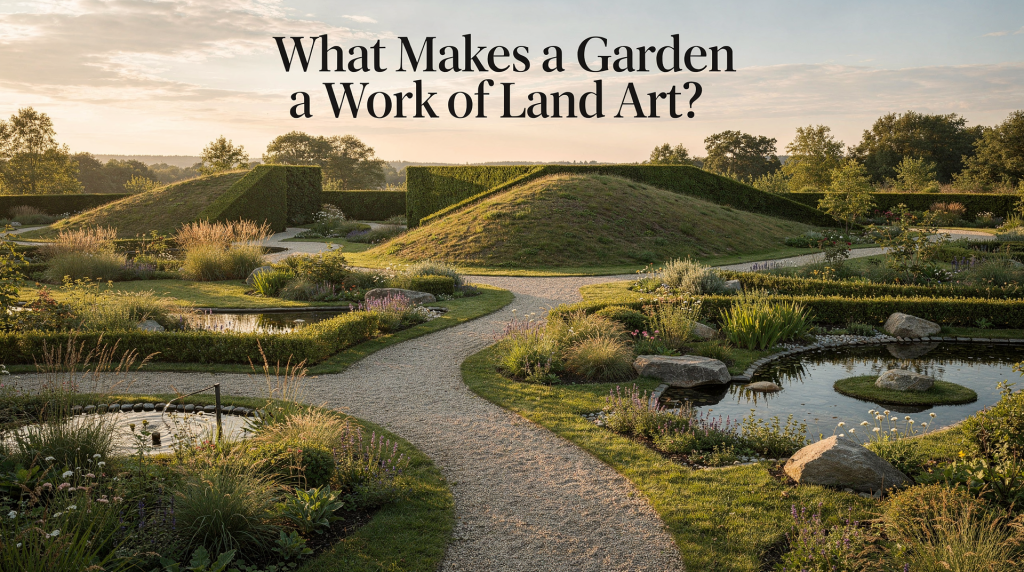
In a land-art garden, topography is never background. It is the subject. A mound, a dip, a retaining edge, a rill cut into the earth, a path carved through a slope — these are not afterthoughts or practical solutions dressed up with planting. They are deliberate sculptural gestures that shape how you move, what you see, and how the space feels underfoot.
I’ve documented this working beautifully even on modest plots. A single level change — say, a sunken seating area excavated from a flat lawn — can create a palpable shift in atmosphere. Suddenly you’re not just standing in a garden; you’re inside the ground. A path that descends gradually between two low earth banks compresses your field of vision before releasing you into an open glade. The landform is doing the storytelling, and the planting simply underscores the narrative.
2. The design feels site-specific
Land art should look as though it could belong nowhere else. It responds to the particular contours, light, climate, soil, views, and existing vegetation of one place. When a design feels generic — a copied curve, a dropped-in earthwork that ignores the horizon line — it reads as a decorative garden feature rather than a genuine response to the land.
A useful test I return to often: if you removed the setting, would the work lose its meaning? In land art, the answer should be yes. The best examples I’ve photographed feel inevitable, as though the designer simply revealed something the site was already suggesting. A chalk slope becomes a series of terraced planes that echo the distant downs. A wet hollow becomes a reflective basin that captures sky and passing cloud. The design doesn’t impose; it listens.
3. Form is as important as planting
Great land-art gardens rely on shape, line, mass, and rhythm — not only on flowers. Planting can soften or intensify the composition, but it should not carry the entire design. I’ve seen too many gardens where the structure collapses in winter because the bones were never strong enough to begin with.
Typical form-led elements I look for include:
- earth mounds and cuts that define spatial volumes
- geometric lawns that read as planes rather than mere ground cover
- sculpted terraces that step the eye down a slope
- water channels and basins that draw a line across the land
- walls, steps, and ramps that choreograph movement
- repeated structural planting — hedges, grasses, specimen trees — used rhythmically
- paths that don’t just connect points but compose the journey
When these elements are in place, the garden holds its shape through every season. The planting becomes a layer that animates the structure rather than the thing that defines it.
4. The experience unfolds over time
Land art is rarely understood in one glance. It reveals itself through movement, sequence, and changing conditions. From the house, you might see a composed geometric lawn framed by hedging. Walk closer, and a hidden rill appears, cutting across the grass. Climb to higher ground, and the whole composition snaps into a different reading — the lawn now a green plane suspended between earth and sky.
That temporal quality also includes seasons. A work that reads strongly in winter — when the bones are bare and the light is low — is often stronger than one that depends on a single peak moment in June. I’ve learned to judge gardens in February as much as in July. Frost on a sculpted earthwork, the skeletal line of a winter hedge, the way water sits in a basin after rain: these are the moments that test whether a design has genuine depth.
5. Material choices stay honest
Land art usually feels rooted in natural or site-derived materials: soil, stone, water, timber, gravel, turf, and planting. Even when a garden includes built elements — a concrete retaining wall, a steel edge — they should support the land’s character rather than overpower it. The material palette should feel as though it emerged from the site, not from a catalogue.
A polished, over-finished palette can weaken the effect. I’ve watched beautifully conceived earthworks lose their power because the gravel was too uniform, the stone too precisely cut, the timber too smoothly planed. Land art works best when it allows the grain of the materials, the weathering of surfaces, and the irregularity of nature to remain visible. Let the stone show its bedding planes. Let the timber silver and check. Let the gravel shift underfoot. These are not flaws; they are the work breathing.
What separates land art from a conventional landscaped garden?
| Feature | Conventional garden | Garden as land art |
|---|---|---|
| Main focus | Planting, comfort, use | Site form, spatial composition, experience |
| Role of terrain | Usually practical | Central design element |
| Materials | Often ornamental and mixed | Often natural, site-led, restrained |
| Visual effect | Attractive and managed | Sculptural, conceptual, place-specific |
| Relationship to time | Seasonal planting display | Changes with weather, growth, and erosion |
| Visitor experience | Immediate overview | Sequence, discovery, layered viewpoints |
This table isn’t about ranking one approach above the other. A conventional garden can be deeply satisfying. But the distinction matters when you’re trying to understand why some spaces feel fundamentally different — why they linger in memory long after you’ve left.
Signs a garden is moving into land-art territory
Strong spatial structure
You can read the garden in terms of rooms, thresholds, axes, edges, and pauses. The planting supports that structure instead of hiding it. When I photograph a garden with strong spatial bones, I can compose images in any season and the framework still holds. Hedges read as walls. Lawns read as floors. A gap between two yew hedges becomes a doorway, and the space beyond feels like a discovery.
Meaningful landform
The slope, dip, or raised plane does more than solve drainage or create level access. It creates drama, orientation, or enclosure. I’ve stood in gardens where a single earth mound — no more than a metre high — completely transformed the experience of the space, blocking the view of a neighbouring house and framing the sky in a way that felt almost architectural.
Clear point of view
There is often an intentional relationship between the house and the garden, or between one viewing point and another. The design considers how the work is seen from windows, terraces, paths, and distant edges. In the best examples I’ve documented, the view from the kitchen window is just as composed as the view from the far end of the garden looking back. Nothing is accidental.
Repetition with variation
Land art often uses a repeated geometry or recurring material, but never in a mechanical way. The repetition gives order; the variation gives life. A row of pleached hornbeams might march across a terrace, but the spacing shifts slightly as the ground falls away. A series of stone steps might repeat the same riser height while the treads widen and narrow in response to the slope. The pattern is there, but it breathes.
A sense of authorship
A land-art garden has a strong point of view. You can feel that the designer made deliberate decisions about scale, restraint, and rhythm. There’s a clarity of intent that cuts through the noise. When I walk into a garden like this, I don’t need to be told who designed it; the handwriting is visible in every decision, from the width of a gravel path to the choice of a single specimen tree placed at a key axis.
How to design a garden that feels like land art
Step 1: Study the site before drawing
Walk the garden at different times of day, in different weather, across different seasons if you can. Note where the ground naturally rises or falls — not just the obvious slopes, but the subtle undulations that most people overlook. Watch where water sits after rain; these are the places the land is already telling you something. Identify which views are worth framing and which are better screened. Feel where the wind is strongest — that’s where you’ll need shelter, or perhaps where you’ll place grasses that animate in the breeze. Mark exactly where the house connects to the outdoors, because those thresholds will anchor the entire composition.
This stage is about reading the land, not imposing an idea on it. I’ve seen too many designs fail because someone fell in love with a sketch before they’d spent an hour just standing in the space.
Step 2: Decide what the landform should do
Ask whether the ground is meant to create movement, hide or reveal views, divide one space from another, hold water, frame planting, or give a sense of calm and enclosure. A successful land-art garden usually has one or two clear spatial ambitions. Too many ideas dilute the result. I’ve learned to be ruthless at this stage: if an earthwork isn’t doing at least one of these jobs clearly, it’s probably just decoration.
Step 3: Simplify the palette
Choose a limited material vocabulary. For example: turf, gravel, and stone. Or brick, hedging, and water. Or earth, timber, and meadow planting. A restrained palette makes form easier to read and gives the garden a more coherent identity. When I photograph gardens with too many materials — six types of paving, four colours of gravel, three different wall finishes — the eye doesn’t know where to rest. The landform disappears under the visual noise.
Step 4: Treat planting as part of the composition
Planting should reinforce the structure of the land, not compete with it. Use planting to soften hard edges, emphasize lines or curves, direct movement, create seasonal change, and frame key views. A mass of deschampsia at the base of a retaining wall can blur the transition between built and grown. A line of fastigiate hornbeams can draw the eye along an axis more powerfully than any path. The planting is there to serve the spatial idea, not to steal the show.
Step 5: Design for change
Land art is strongest when it accepts growth, weathering, and seasonal variation. Choose plants and materials that improve with age. A corten steel edge that rusts to a deep orange over five years. A gravel path that settles and acquires a patina of moss. A yew hedge that slowly thickens into a solid dark wall. Make sure the design still works when leaves fall, stems die back, or surfaces weather. I always test a design mentally by picturing it in late January: low light, bare branches, maybe a skim of ice on the water. If it still holds together, it’s probably robust enough.
Common mistakes to avoid
- Overdecorating the space so the landform disappears under furniture, pots, and ornament
- Using too many materials, which breaks visual unity and makes the garden feel restless
- Adding sculptural gestures without spatial purpose — a mound that doesn’t enclose, a rill that leads nowhere
- Ignoring drainage, access, or maintenance realities; land art isn’t an excuse for poor detailing
- Relying on planting alone to create impact, leaving the garden hollow in winter
- Making the garden look like a theme park version of land art — all gesture, no depth
A garden can be artistic and still fail if it is impractical. The best land-art gardens are rigorous, not precious. They work as gardens first, and as art because of how well they work.
When land art works best in residential settings
Land art is especially effective in country houses with strong topography, where the land already has something to say and the design can amplify it. Modern homes with clear architectural lines also lend themselves well — the geometry of the building can extend into the landscape as terraces, planes, and linear water features that feel like a continuation of the architecture. Terraces that step down toward open land offer a natural opportunity to sculpt the ground in a way that mediates between the domestic and the wild. Small estates where circulation can be choreographed — where you can design a sequence of arrival, compression, and release — are ideal. And private gardens that need identity without clutter often benefit most from a land-art approach: when the ground itself carries the design, you don’t need to fill every corner with objects.
In residential design, the aim is often not spectacle. It is atmosphere: a garden that feels calm, intentional, and deeply tied to place. The kind of space where you walk out in the morning with a cup of coffee and feel the ground under your feet in a way you never quite did before.
A simple checklist for evaluating a land-art garden
- Does the design respond to the site’s natural shape, or does it fight it?
- Is the terrain part of the composition, or just a surface to decorate?
- Are the materials restrained and coherent, or is there visual clutter?
- Does the garden reveal itself in stages, or is everything visible at once?
- Do planting and hardscape support the same idea, or are they pulling in different directions?
- Would the garden still make sense in another location? If not, that is a good sign.
- Does it change beautifully with seasons and weather, or does it collapse without its summer planting?
FAQ
Is every sculptural garden land art?
No. Sculptural gardens can still be mainly decorative — a collection of interesting forms placed within a conventional garden framework. Land art requires a stronger relationship between the site, the terrain, and the overall spatial idea. The sculpture in a land-art garden isn’t an object placed on the ground; the ground itself is the sculpture.
Can a small garden be land art?
Yes. Scale is less important than intent. Even a compact urban garden can use level changes, framing, repetition, and material restraint to create a land-art effect. I’ve seen a courtyard no larger than six metres square feel monumental because the designer cut a single slot through a raised stone plane, filled it with water, and let the sky do the rest.
Does land art have to be temporary?
Not necessarily. Some land art is deliberately ephemeral — works that erode, flood, or blow away over time. But many garden-based works are durable and designed to evolve rather than disappear. A yew hedge thickens. A gravel path settles. A corten wall rusts. The work changes, but it doesn’t vanish. That slow transformation is part of its power.
What role does planting play?
Planting is essential, but usually as part of a larger composition. It supports form, movement, and atmosphere rather than carrying the whole design on its own. Think of planting as the voice that animates the structure, not the structure itself. When the planting recedes in winter, the bones should still hold the space.
How can you tell if a garden feels like land art?
If the ground, space, and sequence feel just as intentional as the planting, and the garden seems inseparable from its site, it likely has land-art qualities. Another clue: you find yourself noticing the shape of the land, the way the light falls across a slope, the sound of gravel underfoot, the slow reveal of a view — not just the flowers.
Conclusion
A garden becomes land art when it is designed as a place-specific composition of land, form, movement, and change. The strongest examples do not simply decorate the site; they reveal it, shape it, and make the visitor experience the terrain in a more conscious way. You walk differently in a land-art garden. You look at the ground. You notice the horizon. You feel the weight of the earth under your feet.
For residential gardens, that does not always mean dramatic earthworks or large budgets. Often it means clearer thinking: simpler materials, stronger spatial structure, more attention to the ground underfoot, and a design that feels inseparable from the place it belongs to. The most memorable private gardens I’ve documented share this quality: they don’t shout for attention. They simply feel right — as though the land had been waiting for someone to notice what it could become.