Designing a Garden Around Movement, Views, and Discovery
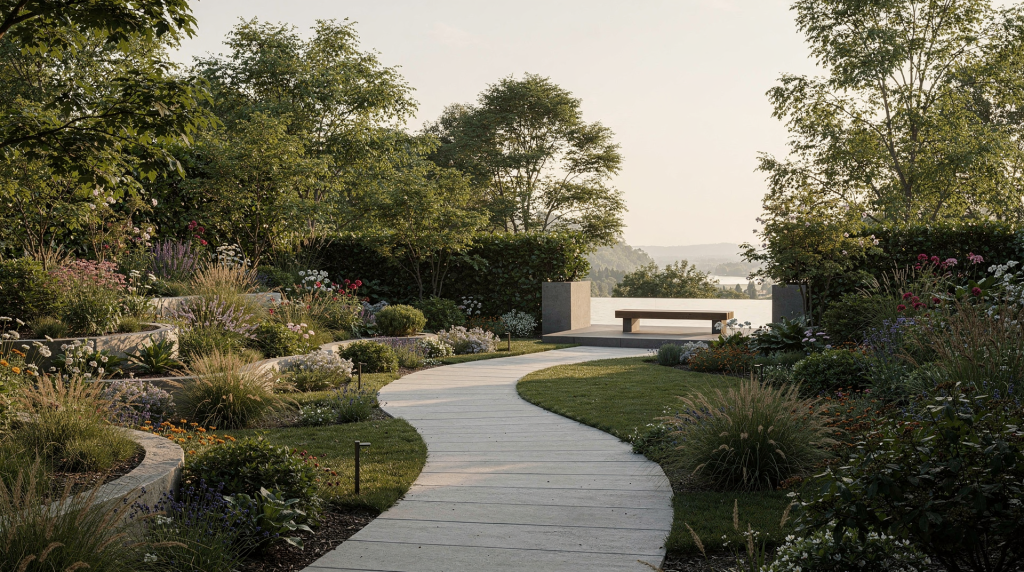
A garden reveals its true character not in a single photograph, but in the walk. The way a path turns, the moment a view opens, the deliberate pause before something hidden comes into sight—these are the experiences that lodge in memory. When I document private gardens, I look for this choreography. The most compelling spaces are rarely the ones that display everything at once. They are the ones that understand pacing.
Designing around movement, views, and discovery is not about adding more features. It is about sequencing. A garden becomes a series of invitations rather than a static picture. And when that sequence works, even a modest plot can feel expansive, layered, and deeply personal.
Why movement matters in garden design
Movement is the skeleton beneath the planting. I have walked through gardens where the horticulture was impeccable—rare specimens, perfect pruning—yet the experience felt disjointed. The reason was almost always circulation. Without clear intent behind where and how people move, a garden becomes a collection of beautiful moments that do not quite connect.
Circulation tells the body what to do: walk here, pause there, turn now. It makes the difference between a space that feels inviting and one that feels like an obstacle course. The practical starting point is deceptively simple. Before thinking about plants or materials, I ask:
- Where do people enter the garden?
- Where do they naturally want to go?
- Which views should be open and immediate?
- Which views should be delayed and revealed gradually?
- What should remain hidden until you are closer?
When those answers are clear, every subsequent decision—paving, planting, levels, seating, focal points—has a logic to follow. The design becomes coherent rather than decorative. I have seen this transform awkward plots where the client felt lost, simply by establishing a primary route and then building the garden outward from that line.
The three design tools that shape the experience
1. Movement
Movement is the physical journey through the garden. Straight routes create clarity and efficiency—they are the working paths, the ones you take with a cup of coffee or an armful of firewood. Curved routes slow the pace and encourage exploration; they belong to the wandering hours. The most livable gardens I know combine both. A direct flagged path from the back door to the terrace, for instance, with a secondary gravel track that loops through the perennial border and disappears behind a hedge. One serves daily rhythm, the other serves curiosity.
2. Views
Views are what the eye catches from key positions—the kitchen window, the patio chair, the doorway where you pause before stepping out. Strong sightlines anchor a garden. They give it intention. Without them, the eye drifts restlessly across the space, never quite settling. A well-placed view feels almost architectural: a clean line from a doorway to a specimen tree, or from a bench to a borrowed piece of countryside beyond the boundary. These are not accidents. They are composed.
3. Discovery
Discovery is the controlled reveal. It is the reason a garden feels larger and richer than its square footage suggests. Instead of showing everything at once, the space unfolds in sections. A hedge, a wall, a mass of planting, a change in level, a bend in the path—each can hide part of the garden and make the next view feel earned. I think of this as the garden’s quiet drama. It does not shout. It simply waits until you are close enough to see.
Start with the house and the main viewpoints
The best garden layouts begin indoors. I always spend time standing at the windows and doors the family uses most often, noting exactly what the eye meets. These are the primary sightlines, and they need to work from day one, even when the planting is young and the trees are still stakes with leaves.
The positions that matter most:
- Kitchen window—often the most-used viewpoint in the house
- Living room window—where the garden is seen in repose
- Back door—the threshold where inside meets outside
- Main terrace seating area—where people sit and look outward
- Dining table or breakfast position if it faces the garden
If a view feels weak, I look for the cause. Often it is not a lack of plants, but a lack of structure. Clutter, an empty middle distance, or no clear place for the eye to rest. The fix might be as simple as repositioning a path so it leads the gaze, or placing a single shrub or pot where the sightline naturally terminates. One well-placed element can resolve a view that has felt unresolved for years.
How to design sightlines that feel natural
A sightline is an invisible thread that pulls the eye from one point to another. In garden design, that thread might connect a doorway to a tree, a terrace to a sculpture, or a path opening to a gate. When it works, the effect is almost subliminal—the garden simply feels right. When it fails, the space feels aimless.
To use sightlines well, I follow a few principles:
- Place a focal point at the end of a path—something that rewards the walk
- Align a view with a specimen tree, bench, pot, sculpture, or water feature
- Use planting to frame the view rather than block it—think of it as a window frame in foliage
- Keep the line clear enough that the destination feels obvious, not ambiguous
- Repeat structural plants on both sides when you want a stronger corridor effect—this creates a sense of procession
A simple diagnostic helps: if the eye keeps drifting without landing anywhere, the design needs a focal point. If the eye is trapped too quickly, the garden needs more depth or a gentler transition. I often test this by photographing the view and then looking at the image later. The camera is brutally honest about where the eye goes.
Designing for discovery rather than full visibility
A garden that is visible all at once can feel flat, no matter how beautiful the planting. Discovery comes from partial concealment. The visitor sees enough to be interested—a glimpse of stone, a hint of color beyond a hedge—but not enough to understand the whole garden immediately. This is the difference between a space that is merely seen and one that is explored.
Useful ways to create discovery:
- Turn a path slightly so the end is not visible from the start—the curve itself becomes a question
- Use a hedge, wall, or tall planting to screen a second space—yew, hornbeam, or a simple trellis with climbers
- Place seating around a corner rather than directly on the main axis—a bench tucked behind a shrub feels like a secret
- Introduce a change in level—even two steps down into a lower garden can transform the experience
- Let an arch, pergola, or gap in planting frame the next view—like a doorway into another room
This approach is especially effective in medium and larger gardens, where the challenge is not fitting everything in, but making the journey feel considered. I have walked through gardens where a single well-placed hedge created three distinct experiences where previously there was just one open lawn. The space did not change size. The experience of it doubled.
Straight paths, curved paths, and when to use each
| Path type | Best use | Effect on movement | Effect on views |
|---|---|---|---|
| Straight path | Everyday access, formal layouts, direct connection between house and destination | Fast, clear, practical | Strong sightline, immediate focus |
| Curved path | Informal gardens, larger plots, exploratory planting areas | Slower, more relaxed, encourages wandering | Delays the reveal and adds curiosity |
| Diagonal path | Linking side areas, widening the sense of space | Efficient without feeling rigid | Extends views and can make a garden feel larger |
I use straight lines where function matters most—the route from the back door to the compost, the link between terrace and vegetable garden. I use curves where atmosphere and surprise matter more—the path that meanders through a wildflower area or loops around a pond. The best gardens I document combine both, often with a formal route near the house that gradually softens into something looser as you move further from the architecture. This transition mirrors the way the house itself gives way to the landscape.
How to make a garden feel larger
Movement, views, and discovery are not just aesthetic tools. They are spatial tools. A long view from the house to a focal point can extend the perceived depth of a plot by a surprising margin. Diagonal sightlines can make a narrow garden feel broader. Carefully framed openings can create the sense that the garden continues beyond what is visible—even when it does not.
Practical techniques I use repeatedly:
- Keep the main axis open from house to far boundary—resist the urge to fill it
- Use lower planting in the foreground and stronger structure farther away—this exaggerates depth
- Place a focal point at the end of a long view—a bench, a tree, a piece of sculpture
- Avoid blocking the middle of the garden with unnecessary mass—the middle distance is precious
- Use repeated materials or planting to connect separate areas—continuity reads as space
This is especially useful in smaller gardens, where every line matters. I have worked on plots where a single diagonal path, cutting across what was previously a rectangular lawn, made the garden feel half as large again. The square footage did not change. The perception of it did.
A simple planning method you can use
Step 1: Map the key points
Mark entrances, doors, windows, seating areas, storage, and the most important existing views. Be honest about what is actually there, not what you wish was there.
Step 2: Decide the main route
Choose the path people will use most often. This should be the clearest and most comfortable line through the garden. It is the spine everything else attaches to.
Step 3: Mark the focal points
Place one or two focal points where the eye naturally wants to stop: the end of a path, a turning point, or a view from the house. These are your punctuation marks.
Step 4: Add layers of concealment
Use planting, walls, or changes in level to hide secondary areas until someone moves closer. Think of it as editing the garden’s story—not everything needs to be in the first sentence.
Step 5: Test the experience
Walk the route slowly. Ask:
- Do I know where to go?
- Is there something worth moving toward?
- Does each turn reveal something better?
- Is the garden interesting from inside the house as well as outside?
This last step is where theory meets reality. I have adjusted paths by a few degrees after walking them repeatedly, just to get the reveal right. Small shifts can make a large difference.
Planting decisions that support movement and views
Planting should reinforce the design, not fight it. I see this mistake often: beautiful plants placed where they block a critical sightline or crowd a path so walking becomes uncomfortable. Structural planting is especially useful where the garden needs definition, framing, or direction. Clipped evergreens, repeated shrubs, and small trees can act like punctuation marks in the layout—they give the eye anchors.
Good planting strategies:
- Use lower planting near paths so circulation stays comfortable—nobody wants to brush against wet foliage every morning
- Place taller planting where you want enclosure or partial screening—this creates rooms within the garden
- Repeat a few key plants to create rhythm—repetition is the gardener’s equivalent of a recurring motif
- Use seasonal planting for the softer, middle layers—let the structure hold the garden through winter
- Keep focal areas simpler so they read clearly—a busy border around a sculpture weakens both
Avoid packing every border with high-impact planting. Too much visual noise weakens the sense of direction. The eye needs moments of calm to appreciate the moments of intensity. I often think of planting design as composing a piece of music: silence and restraint are as important as the notes themselves.
Common mistakes to avoid
- Making every route curved, which creates confusion instead of intrigue—the garden becomes a maze without a destination
- Leaving no destination at the end of a path—a path should lead somewhere, not just stop
- Blocking the best view with overgrown planting—vigorous plants need editing, sometimes ruthlessly
- Putting focal points where they are visible but not meaningful—a bench facing a blank wall is not an invitation
- Designing only for standing views and ignoring seated views—the garden looks different from a chair
- Forgetting the garden as seen from inside the house—this is the view you will see most often, especially in winter
Another common mistake is overusing decorative features. A garden only needs a few strong elements if they are placed well. One well-positioned tree, bench, or water bowl often does more than several scattered ornaments. I have removed half a dozen small features from gardens and replaced them with one substantial piece, and the space immediately felt calmer and more intentional.
Checklist for a garden that flows well
- Clear main route from house to key destination
- At least one strong view from the house
- Secondary routes for exploration
- Focal points placed where the eye naturally stops
- Planting that frames rather than crowds the view
- Partial screening to create mystery
- Comfortable transitions between spaces
- Balance between open prospect and sheltered retreat
This checklist is not about ticking boxes. It is about asking whether the garden works as a sequence of experiences. I return to these questions on every project, and the answers are rarely the same twice. Each site has its own logic.
When to work with an axis, and when not to
An axis is a powerful tool. It creates order, formality, and a strong relationship between house and garden. I have used it in classical country gardens where a central door opens onto a long vista framed by pleached limes, and in contemporary schemes where a clean line of stone connects the living room to a horizon. When it suits the architecture, an axis feels inevitable.
You may want an axis when:
- The house has a strong central door or terrace—the architecture demands a response
- The garden is rectangular or symmetrical—the shape invites formality
- You want a formal approach or long view—calm, composed, timeless
- The main experience should feel calm and composed rather than playful
You may want to soften the axis when:
- The plot is narrow or awkwardly shaped—a rigid axis can exaggerate awkward proportions
- The garden needs to feel relaxed rather than formal—a looser layout suits a family garden better
- You want more surprise than structure—discovery thrives on asymmetry
- The site has multiple interesting destinations rather than one central focus—several good views are better than one forced one
The axis is a choice, not a default. I have seen gardens where abandoning a central axis in favor of a diagonal route transformed the space from stiff to inviting. The house still had a presence, but the garden found its own voice.
FAQ
How do you make a garden more interesting to walk through?
Use a mix of direct routes, gentle turns, framed views, and focal points. The garden should reveal itself in stages rather than all at once. Think of it as a story that unfolds, not a poster that shouts.
What is the most important view in a garden?
Usually the view from the main inside-outside connection: the kitchen, living room, or back door. That is where the garden is seen most often and where a strong sightline has the biggest effect. This is the view that greets you every morning, and it should feel like an invitation.
Should every path lead to something?
Yes. Even a short path should end at something deliberate, such as a bench, tree, gate, or planting feature. A destination gives the path purpose. A path to nowhere feels like a broken promise.
How do you make a small garden feel bigger?
Keep one long sightline open, avoid visual clutter, use diagonal views where appropriate, and place a clear focal point at the far end of the garden. The eye needs somewhere to travel, and the further it travels, the larger the space feels.
What creates a sense of discovery in a garden?
Partial concealment, path turns, layered planting, and changes in level. Discovery depends on not seeing everything immediately. The garden should hold something back, so there is always a reason to take another step.
Conclusion
A garden designed around movement, views, and discovery feels more alive because it gives people a reason to move, pause, and look again. It is not a picture to be admired from one spot. It is a sequence of experiences that change with the light, the season, and the route you choose.
The most successful layouts I have documented combine a clear route, well-placed sightlines, and moments of reveal so the garden works as both a practical space and a quiet narrative. When the plan is thoughtful, even a modest garden can feel layered, spacious, and memorable. The size of the plot matters less than the intelligence of the design. And that intelligence shows not in grand gestures, but in the small, considered decisions that make a walk through the garden feel like a conversation.