Geometric Garden Design: Curves, Spirals, and Fractal Patterns
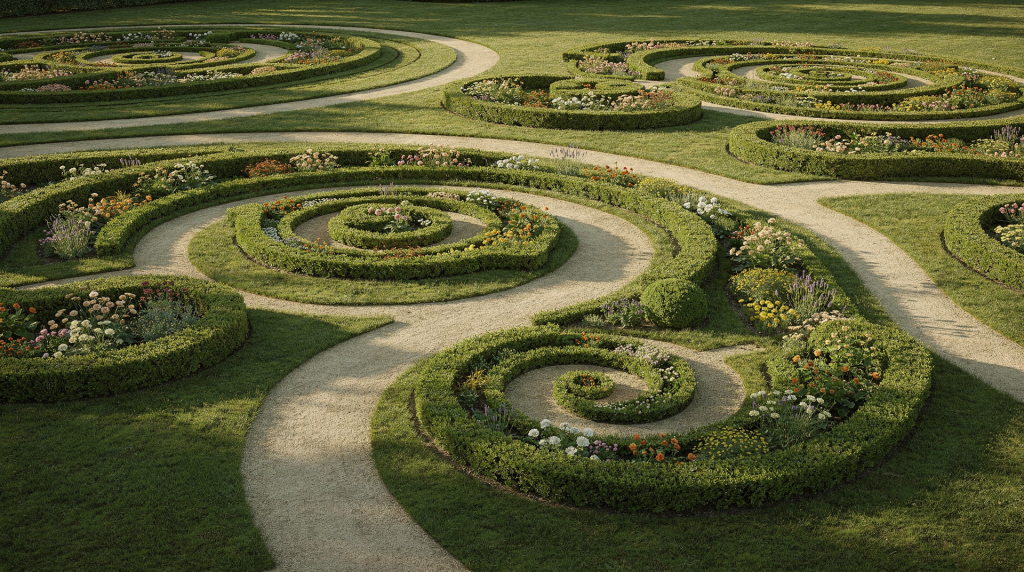
Geometry in a garden isn’t about imposing rigid order on plants. It’s about using curves, spirals, and repeating patterns to give a space legibility, a sense of scale, and a quiet connection to the house it belongs to. In an English garden, those forms can soften a formal layout, guide movement, and create a rhythm that feels deliberate without shouting for attention.
Why geometric design works in gardens
Geometry gives a garden structure. A well-placed curve slows the eye down, a spiral creates a natural focal point, and fractal repetition makes even a modest plot feel coherent at multiple scales. When I walk through a garden that uses these tools well, the space unfolds rather than simply appearing—there’s a sense of discovery, even in a familiar setting.
In practice, this means:
- A curved path can make a narrow plot feel less cramped, drawing you forward without revealing everything at once.
- A spiral bed can concentrate herbs in a compact, easy-to-reach form, while subtly altering microclimates within a metre’s radius.
- Repeated shapes in paving, planting, or borders can tie house and garden together, so the terrace feels like an outdoor room rather than an afterthought.
The strongest designs usually balance two things: clear structure for orientation and maintenance, and soft, natural movement so the space doesn’t feel overdrawn or severe. That balance is what separates a garden that simply looks geometric from one that lives comfortably with its architecture.
Curves: the easiest geometry to use well
Curves are the most forgiving geometric tool in garden design. They work especially well where you want movement, softness, or a more relaxed transition between built form and planting. A curve can take the hard edge off a rectangular terrace or lead the eye away from a utilitarian corner without needing a single straight line.
Where curves are most useful
- Pathways that need to lead the eye around a corner, hinting at something beyond.
- Borders that should loosen a rigid lawn edge, making the mowing line feel less like a military exercise.
- Seating areas that need to feel tucked in, not boxed in—a gentle sweep of gravel or stone can create a sense of enclosure without walls.
- Garden rooms that should connect gradually rather than abruptly, so you drift from one space to the next.
Common mistakes with curves
- Making curves too shallow, which looks accidental, as if the designer lost confidence halfway through.
- Making them too tight, which can feel decorative rather than natural—like a fussy scroll on a Victorian gate.
- Using curves everywhere, which removes clarity and weakens the plan. A garden needs some straight lines to anchor the eye; otherwise, it becomes a restless blur.
A useful rule: a curve should look intentional from both the terrace and the far end of the garden. I often test this in winter, when the bones of the garden are exposed. If the curve only works from one viewpoint, it’s usually not strong enough to hold the space together when the planting dies back.
Spirals: compact form with strong visual logic
Spirals are one of the most efficient geometric devices in a garden because they compress space while still creating movement. They naturally draw attention inward, which makes them useful for focal points, herb gardens, and small circulation areas where you want a sense of flow without sprawling.
Good uses for spiral forms
- Herb spirals that create different moisture and sun conditions—thyme baking at the top, parsley tucked into the cooler, shadier base.
- Gravel or stone features around a central specimen plant, where the spiral acts like a ripple in water, anchoring the eye.
- Small lawns or paving layouts where you want a sense of flow; a spiral of brick or setts can turn a tiny courtyard into a calm, meditative space.
- Decorative planting beds that act as a focal point from the house, especially when viewed from a first-floor window.
Why spirals work
A spiral suggests motion without needing literal symmetry. In design terms, that helps a garden feel dynamic while still contained. In practical terms, it can also create microclimates: the top may be drier and sunnier, while lower areas retain more moisture. I’ve seen a single spiral of corten steel filled with gravel and creeping thyme transform a bare corner into the most photographed spot in the garden.
When not to use a spiral
- In very formal gardens where the house demands strict axial alignment—a spiral there can feel like a whimsical intruder.
- In large flat spaces where the shape would be isolated, floating without connection to any boundary or sightline.
- Where access and maintenance need straight, practical routes; a spiral path to a compost heap is more obstacle than ornament.
Fractal patterns: repetition at different scales
Fractal design means repeating a pattern at more than one scale. In gardens, this can appear in branching paths, repeated planting groupings, or the same shape echoed in beds, paving, and canopy lines. It’s a quiet way of making a garden feel deeply coherent, as if every part belongs to the same family of forms.
What fractal design looks like in a garden
- A main path that splits into smaller secondary paths, mimicking the branching of a tree.
- A large border made up of repeated plant masses—three clumps of Miscanthus here, three there, the rhythm holding the eye.
- A tree canopy echoed by shrub layers below, so the shape of an oak’s crown is repeated in a lower ring of box or yew.
- Similar curves repeated in the terrace edge, bed line, and hedge outline, so the whole garden reads as one composition.
This matters because the human eye reads repetition quickly. When the same logic appears at different scales, a garden feels ordered even if it is not symmetrical. I’ve photographed gardens where a single sweeping curve—first in the ha-ha, then in the border, then in the cloud-pruned hedge—made a five-acre plot feel intimate and intentional.
A simple way to think about it
If a curve, cluster, or branching line appears once, it is just a shape. If it appears again in smaller or larger form, it becomes a pattern. That is what gives fractal-inspired gardens their depth. It’s the difference between a one-off gesture and a language.
How to choose between curves, spirals, and fractals
| Form | Best for | Strength | Risk |
|---|---|---|---|
| Curves | Paths, borders, transitions | Softens rigid spaces | Can look vague if overused |
| Spirals | Small features, herb gardens, focal points | Strong visual pull | Can feel gimmicky in formal settings |
| Fractals | Whole-garden coherence | Creates depth and unity | Easy to make too busy |
In English gardens, the most successful schemes often combine all three: curves for movement, spirals for detail, and fractal repetition for structure. The key is restraint—letting one form dominate while the others play a supporting role.
A practical design process
1. Start with the house
Look at the architecture first. A Georgian or highly formal house often suits clearer geometry—strong axes, symmetrical beds—while a contemporary rural home may welcome softer curves and repeated natural forms. The garden should feel like it belongs to the building, not just to the site. I always check how the eye travels from the main windows: the geometry should pull you out into the landscape, not stop at the terrace edge.
2. Map the movement
Mark how people actually use the space:
- From kitchen to terrace.
- From terrace to lawn.
- From garden gate to back door.
- From seating area to utility areas.
This is where curves and branching lines become useful. The geometry should support movement, not obstruct it. A path that looks elegant on paper but forces you to walk an extra thirty metres to the log store will quickly become a source of irritation.
3. Choose one dominant pattern
Do not try to use every geometric idea at once. Pick one main language:
- Curves for a relaxed, flowing garden.
- A spiral focal point for a small plot or courtyard.
- Fractal repetition for a layered, naturalistic scheme.
4. Repeat the pattern quietly
Repeat the chosen shape in at least three places:
- Hard landscaping.
- Bed edges.
- Plant grouping or canopy structure.
That repetition is what makes the scheme feel designed rather than improvised. It doesn’t need to be obvious; it just needs to be consistent enough that the subconscious registers it.
5. Test it on paper and on site
Before building, check:
- Does the shape still work from upstairs windows? Often a curve that looks generous at ground level feels mean from above.
- Does it make maintenance harder? A spiral bed with tight corners can be a nightmare to mow around.
- Does it leave enough straight space for mowing, furniture, or access?
- Does it still feel good in winter, when planting is sparse? I often visit gardens in February specifically to see if the geometry holds up without foliage.
Planting strategies that support geometry
Planting can strengthen geometry or destroy it. The best designs use plants with clear masses, readable rhythms, and a sensible contrast between line and softness. A crisp box hedge can define a spiral, but if you fill it with a jumble of airy perennials, the shape dissolves.
Useful planting approaches
- Repeated clumps of the same plant to echo a fractal rhythm—three Euphorbia, then three more further along, like a visual drumbeat.
- Low edging plants to define a curved or spiral boundary; Teucrium or Santolina can hold a line without looking stiff.
- Structural shrubs to anchor intersections and turning points, so the geometry has a physical presence even in midwinter.
- Layered planting that repeats shapes at ground, mid, and upper level—a low groundcover curve, a mid-level shrub curve, and a canopy curve that mirrors both.
Planting mistakes to avoid
- Too many species in one pattern, which turns a clear gesture into visual noise.
- Fussy edging that competes with the shape; if the border edge is more intricate than the geometry, the pattern gets lost.
- Tall planting where the geometry needs to stay visible—a spiral hidden under six-foot grasses is just a mound.
- Strong patterning without enough evergreen structure for winter; the garden should read as a composition even under frost.
Materials that suit geometric garden design
The choice of materials can make or break the design language. A graceful curve drawn in cheap concrete pavers will never feel as considered as the same line executed in reclaimed brick or local stone.
Best materials for geometric layouts
- Gravel for curved circulation and informal spirals—it takes the shape beautifully and crunches underfoot, adding another sensory layer.
- Brick or stone for precise edges and repeated modules; a brick-on-edge border can trace a fractal pattern with quiet authority.
- Corten steel or timber for clean line control; a steel edge holds a curve with absolute precision, contrasting with soft planting.
- Paving units in consistent sizes for fractal-like repetition; when the module is the same, the pattern reads clearly even from a distance.
Material rule of thumb
If the form is soft, the material should still be disciplined. If the form is strict, the planting can provide the softness. I’ve seen a severe rectangular pool transformed by a single sweep of Deschampsia along one edge—the geometry stayed, but the mood softened entirely.
A simple checklist before you build
- The geometry relates to the house, not just the garden—there’s a visual thread from the façade to the furthest bed.
- The main shape can be read from the terrace and from the end of the plot; it works in both directions.
- Paths have a practical width and turning radius; a wheelbarrow can navigate them without clipping the edges.
- Maintenance access has been planned—mowing strips, stepping stones, or clean gravel margins.
- The pattern is repeated enough times to feel intentional, but not so often that it becomes wallpaper.
- There is enough restraint to avoid visual clutter; negative space is as important as the pattern itself.
Typical mistakes in geometric garden design
- Using curves just to avoid straight lines—a wobbly path is not a design decision.
- Mixing too many patterns in one small space; a spiral, a fractal, and a serpentine border in fifty square metres will just confuse the eye.
- Forgetting that sightlines matter as much as planting; a beautiful curve that leads straight to a compost bin is a missed opportunity.
- Designing a beautiful drawing that cannot be maintained; if the geometry requires weekly trimming with nail scissors, it won’t last.
- Making a spiral or fractal feature without any link to the wider plan—it becomes an isolated novelty rather than part of the garden’s language.
The most common problem is overcomplication. Geometry should clarify the garden, not turn it into a puzzle. When I look at a garden and can’t immediately grasp the main move, I know the designer has tried to say too much at once.
When geometric design is especially effective
Geometric ideas are particularly useful in:
- Small urban gardens that need strong structure to feel larger than they are.
- Country gardens where house and landscape must feel connected; a repeated curve can tie a contemporary extension to a rolling field.
- Courtyards that need order and enclosure; a spiral or fractal pattern can make a confined space feel expansive.
- Terraces and outdoor rooms that extend the architecture; the geometry of the house steps down into the garden through paving patterns and planting lines.
They are less effective when the site is so open or irregular that the pattern has no edges to hold it. In a vast, windswept field, a single spiral would look lost; there, the geometry might need to come from the landform itself rather than imposed shapes.
FAQ
What is geometric garden design?
It is a way of shaping a garden with clear forms such as curves, circles, spirals, and repeated patterns so the space feels structured and readable. It’s about giving the eye a path to follow and the mind a sense of order, without sacrificing the softness of plants.
Are curves better than straight lines in gardens?
Neither is inherently better. Curves soften and guide movement, while straight lines create clarity and calm. The best gardens usually combine both—a straight axis for the main view, a curved path to lead you into the borders.
What is a spiral garden used for?
A spiral garden is often used for herbs or focal planting because it saves space, creates visual movement, and can form different growing conditions within one structure. It’s a compact, three-dimensional way of packing a lot of interest into a small footprint.
What does fractal mean in garden design?
It means repeating a pattern at different scales, such as a main path that branches into smaller ones or planting masses that echo the same rhythm across the border. The repetition makes the garden feel unified, as if every part belongs to the same design family.
Can geometric design still look natural?
Yes. In fact, the best geometric gardens often feel natural because they mirror patterns found in plant growth, branching, and landscape forms. A curve that follows the line of a distant hill or a spiral that echoes the unfurling of a fern feels rooted in nature, not imposed upon it.
Conclusion
Geometric garden design works best when it is quiet, deliberate, and tied to the architecture of the house. Curves bring movement, spirals create focus, and fractal repetition gives the garden depth and unity. Used well, these forms do not fight nature; they give it a clearer voice—one that speaks of structure, rhythm, and a deep connection to the place.
The practical goal is simple: choose one strong pattern, repeat it with restraint, and make sure every line serves both beauty and use. When you get that right, the garden feels inevitable, as if it grew there alongside the house.