How to Plan a Private Garden as a Sequence of Experiences
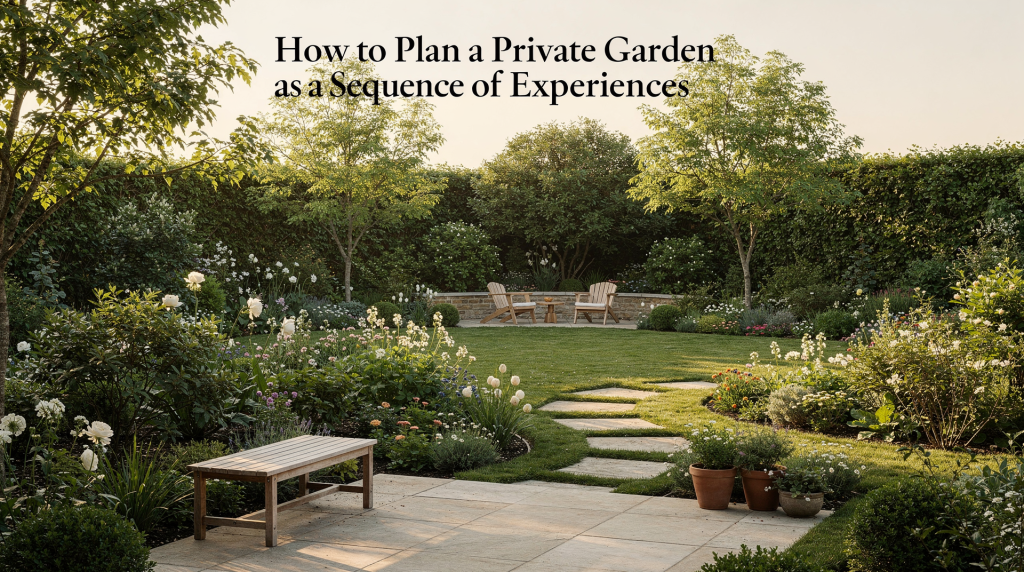
A private garden that stays with you long after you leave it is rarely the one with the most expensive stone or the rarest perennials. It is the one that unfolds. The one where you step out from the kitchen, cross a threshold, and find yourself drawn forward — not by a sign, but by a shift in light, a glimpse of a bench through a gap in the hedge, the sound of gravel underfoot changing to soft bark. That sense of progression is not accidental. It is the result of planning the garden as a sequence of experiences: a deliberate choreography of approach, arrival, pause, movement, and discovery. When done well, the garden feels less like a decorated plot and more like a conversation between the house and the land it sits on.
Why sequence matters in garden design
Walk into a garden where everything is visible at once — the terrace, the lawn, the far fence, the solitary urn — and the eye has nowhere to go. The space registers, but it does not hold. Sequence is what gives a garden temporal depth. It is the difference between a single photograph and a film. By controlling what is seen, when, and from which angle, you create anticipation, memory, and a quiet sense of narrative. Changes in level, shifts in enclosure, the sudden appearance of a focal point after a narrow path — these are the tools that make movement through a garden feel intentional rather than merely functional.
In a private garden, this matters more than in any public park. A family garden is not a spectacle to be consumed once. It is a setting for the small rituals of daily life: carrying a mug of coffee out into the morning air, crossing wet grass in bare feet, moving from a sun-drenched lunch terrace to a shaded corner for an afternoon book. When the sequence is right, these everyday actions feel effortless. The garden supports them without demanding attention. That is the paradox of good residential design: the more carefully the journey is structured, the more natural it feels.
Start with the story of movement
Before a single line is drawn on a plan, I always ask clients to describe the journey they want their garden to tell. Not in horticultural terms, but in emotional ones. What should someone feel in the first thirty seconds after stepping outside? In the first minute? After five minutes of walking? The answers are rarely about plants. They are about release, shelter, surprise, calm.
Think of the garden as a short story with distinct chapters:
- Arrival from the house — the moment of transition from interior to exterior
- First outward view — the initial impression that sets the tone
- Main gathering space — the social heart, where people naturally congregate
- Secondary destination — a reason to move deeper into the garden
- Quiet retreat — a place of solitude, tucked away from the main flow
- Return path — the route back, which should feel different from the way out
This narrative backbone is not a theoretical exercise. It dictates where you open up a view, where you slow the pace with a turn or a step, and where you introduce an element of concealment. A garden that lacks this structure often feels like a collection of nice moments that never quite connect.
Map the garden as a set of outdoor rooms
The most livable private gardens I have documented over the years share a common trait: they read as a series of connected rooms rather than a single open expanse. Each room has a distinct purpose, a particular mood, and a clear reason to move on to the next. This room-based approach makes circulation intuitive. You do not need signs; the space itself suggests where to go.
Typical garden rooms in a residential setting might include:
- Front approach — the first impression from the street or drive
- Main terrace — the transitional space directly off the house, often paved in stone or gravel
- Lawn — an open room for movement, play, and long sightlines
- Dining area — ideally positioned to catch evening light and shelter from wind
- Kitchen garden or productive zone — structured, practical, often enclosed by low hedging or woven willow
- Shade garden — a cooler, leafier room under a canopy of trees or a pergola draped in climbers
- Quiet seating corner — a single bench or pair of chairs tucked into a planting pocket
- Water or wildlife area — a pond, rill, or simple birdbath that introduces sound and reflection
A useful discipline is to give each room one dominant feature — a specimen tree, a piece of sculpture, a stone bench, an urn, a gate, or a dramatic shift in planting mass. This gives the eye a place to rest and anchors the room in memory. Without it, the space can feel diffuse, as if it lacks a subject.
Build the sequence around thresholds
The most memorable transitions in a garden are rarely abrupt. They are thresholds: a single step down onto a different surface, a narrowing of the path between tall grasses, an opening cut through a yew hedge, a change from warm terracotta paving to cool grey gravel. These details speak to the body. They signal, without words, that you are entering a new space.
Thresholds can be created with a restrained palette of moves:
- A single riser or a short flight of stone steps
- A pergola or simple timber arch that frames the passage
- A gate or slatted screen that partially obscures the view beyond
- A deliberate change in paving material — from sawn stone to loose gravel, for instance
- A narrow passage between dense planting that opens out into a wider space
- A pause point — a bench, a large container, a water bowl — that marks the moment of transition
The key is restraint. If every transition shouts, none of them registers. The most effective sequences use quiet thresholds for most moves and reserve a stronger gesture — a framed view, a sudden reveal — for the moments that truly deserve emphasis. The body learns to read these cues quickly, and the garden begins to feel like a place that understands how people move.
Use focal points to pull people forward
A well-placed focal point is one of the most economical tools in a garden designer’s kit. It gives direction without forcing it. In a sequence, focal points act like punctuation: a comma that suggests a pause, a full stop that marks an arrival, an ellipsis that hints at something beyond.
In a private garden, effective focal points tend to be simple and legible:
- A multi-stem birch or a sculptural pine placed at the end of a sightline
- A piece of weathered steel or stone sculpture, half-hidden by foliage
- A timber bench positioned where the path turns
- A still reflecting pool or a single water bowl catching the sky
- A framed view — through a gap in a wall or hedge — of a distant tree or architectural element
- A cluster of large containers at a junction where paths meet
Use them sparingly. One strong focal point per room or zone is usually enough. When multiple focal points compete, the eye flickers between them and the sense of journey collapses into visual noise. The garden should offer a clear invitation, not a list of demands.
Conceal, then reveal
There is a reason the oldest gardens in the world — from Persian paradise gardens to Japanese stroll gardens — rely on partial concealment. Hiding part of the destination and revealing it gradually gives even a modest plot a sense of depth and mystery. It turns a passive view into an active experience of discovery.
In a compact garden, this technique is especially valuable. A straight path from the terrace to the back fence can make a small space feel smaller. But turn that path, screen part of the view with a hedge or a mass of shrubs, and suddenly the garden feels larger than its dimensions. The mind fills in what the eye cannot yet see.
Practical ways to build concealment and reveal:
- Curve a path rather than running it straight, so the destination is hidden until the last moment
- Use a hedge, a line of ornamental grasses, or a slatted screen to block a full view from the house
- Place a focal point just beyond a corner, so it appears as a surprise
- Drop the level of the next room by a step or two, so it emerges gradually as you approach
- Frame a view through a narrow gap — between two walls, through an arch — rather than exposing the whole scene at once
The goal is not to make the garden difficult to navigate. It is to reward movement. Each step should offer something new, something that was not visible from the previous position.
Sequence through planting, not just structure
Hardscape — walls, paths, steps, terraces — gives a garden its bones. But planting gives it atmosphere, and atmosphere is what carries the sequence through the seasons. Gradual changes in texture, height, and colour can guide the eye and the body as effectively as any architectural device.
A simple planting sequence might move from coarse, architectural foliage near the house — hostas, rodgersia, fatsia — to medium textures in the central zone, and then to fine, airy grasses and perennials in the quietest, most distant part of the garden. This shift in texture creates a subtle sense of progression. The garden feels more refined, more delicate, as you move deeper into it.
Colour can work in a similar way. A sequence might begin with pale, open planting at the entry — whites, soft blues, silvers — move through richer, denser planting in the middle, and end with darker, more saturated tones toward the back: deep purples, burgundies, forest greens. The effect is almost subliminal, but it registers. The garden feels as though it has a beginning, a middle, and an end, even when the structure is simple.
Seasonal change is part of this too. The most effective plant groupings offer more than one moment of interest across the year — spring blossom, summer volume, autumn colour, winter structure. A sequence that works in June but collapses in November is only half-designed.
Plan the garden from inside the house outward
A private garden should begin at the house, not at the boundary fence. The views from key windows and doors are not incidental — they are the starting points of the sequence. What you see from the kitchen sink, the dining table, the main bedroom, the sitting room sofa: these are the frames that shape how the garden is first understood.
I often spend the first hour of a site visit simply standing at windows and doorways, noting where the eye goes. That first glance from the main door is particularly important. It sets the expectation. If the view is too open, too exposed, the garden can feel flat before you even step outside. If it is too closed, it can feel unwelcoming.
Practical questions to ask when planning from the inside out:
- What is the first view from the main door? Does it invite or overwhelm?
- Where does the eye go from the kitchen window? That is often the most-used view in the house.
- Which outdoor space will be used most frequently? It should be the most accessible, the most sheltered, and the most immediately usable.
- Where should the view stop? A borrowed landscape, a specimen tree, a wall — something needs to hold the eye.
- What should be hidden until someone actually moves outside? A vegetable garden, a composting area, a quiet retreat — these gain power from being discovered rather than displayed.
When the garden is planned from the inside out, the first zone closest to the house feels like an extension of the interior: paved, furnished, lit. Deeper zones become progressively more immersive, more private, more planted. The transition from architecture to nature happens gradually, and the house and garden feel like a single, continuous living space.
A simple framework for sequencing a private garden
| Stage | Purpose | Design tools | Typical mistakes |
|---|---|---|---|
| Approach | Create expectation | Gate, path, framing, low planting | Too much visibility too soon |
| Arrival | Set the tone | Terrace, threshold, focal point | No clear place to pause |
| Transition | Move between spaces | Steps, narrowing path, planting shift | Abrupt change with no cue |
| Main room | Support daily use | Seating, lawn, dining area | Overcrowding the centre |
| Destination | Reward movement | Sculpture, water, bench, view | Weak or hidden endpoint |
| Return | Keep circulation natural | Loop path, secondary route | Forcing people to retrace steps exactly |
Step-by-step: how to plan the sequence
1. Mark the existing movement lines
Before imposing a new geometry, watch how people already move through the site. Most gardens have informal routes worn into the grass or gravel by habit — the shortcut to the shed, the path to the washing line, the route the dog takes. These desire lines are often more valuable than a purely symmetrical plan because they reflect real use. Work with them, not against them.
2. Identify the main destinations
List every place someone actually wants to be: the morning coffee spot, the evening dining terrace, the play area, the vegetable beds, the tool shed, the firepit, the quiet seat under the tree, the pool or pond. These are the destinations that will anchor the sequence. If a destination does not exist yet but is desired, mark where it might go.
3. Decide the mood of each zone
A garden room should feel distinct from its neighbours. One might be open, sunny, and social — a terrace with generous seating and a long view. Another might be enclosed, shaded, and calm — a bench tucked into a corner with ferns and the sound of water. Another might be productive and practical — raised beds, a compost area, a small greenhouse. The contrast between these moods is what makes moving through the garden feel like a journey rather than a repetition.
4. Connect the zones with transitions
Once the rooms are identified, design the connections between them. A change in paving material — from stone to gravel to bark — can signal a shift in character. A step down or up changes the body’s relationship to the space. A narrowing of the path between tall planting slows the pace and builds anticipation. Each transition should feel like a deliberate cue, not an afterthought.
5. Add one reason to continue
Every space in the sequence should offer at least one reason to keep walking: a glimpse of a bench further on, the scent of a philadelphus or a daphne, the sound of water from a hidden rill, a change in light as the path enters shade. These small invitations accumulate. They turn a functional walk into an experience.
6. Test the experience on foot
Walk the garden slowly, at the pace of someone who has no agenda. Pause where the path turns. Look back toward the house. Notice where the sequence feels rushed or where it stalls. If a transition feels abrupt or a destination feels underwhelming, simplify. Often the best fix is to remove something rather than add something. A garden sequence should feel inevitable, not effortful.
Common mistakes to avoid
- Making every part of the garden equally visible from the house — this flattens the experience and removes any incentive to explore
- Using too many focal points — when everything demands attention, nothing receives it
- Letting paths feel purely functional — a straight, narrow concrete strip from door to shed does nothing for the spirit
- Ignoring the relationship between doors, windows, and outdoor spaces — the view from inside is as important as the view from outside
- Overdesigning transitions — if every threshold is marked by an arch, a gate, and a change of material, the garden starts to feel like a theme park
- Forgetting that wet weather, winter, and evening light change the experience — a sequence that works only in July sunshine is not a sequence, it is a holiday snapshot
A good sequence works in all seasons, in all weathers, and at all times of day. The bare bones of the garden — the paths, the levels, the walls, the evergreens — should carry the structure even when the perennials have died back and the trees are bare.
Checklist for a garden sequence that works
- The garden has a clear beginning, middle, and end
- Each outdoor room has a different function or mood
- Views are revealed gradually, not all at once
- Focal points are placed intentionally, one per zone
- Thresholds signal movement between spaces without shouting
- Planting changes — in texture, height, or colour — support circulation
- The route makes sense from inside the house, starting with the most-used doors and windows
- There is at least one reason to explore further, visible from each stopping point
FAQ
What is a sequence of experiences in garden design?
It is the way a garden is arranged so that moving through it feels progressive — with deliberate changes in view, mood, spatial character, and sensory detail. The garden unfolds over time rather than presenting itself all at once.
How many focal points should a private garden have?
Usually one strong focal point per room or zone is enough. More than that can dilute the effect and create visual competition. The eye needs a place to rest, not a list of things to look at.
Do small gardens need a sequence too?
Yes. In small gardens, sequence is often even more critical. Careful concealment, reveal, and threshold design can make a compact space feel significantly larger and richer than its actual dimensions. A tiny garden with a well-planned sequence can feel like a world; a large garden without one can feel like a field.
What creates the strongest sense of movement?
A mix of paths, level changes, planting transitions, and well-placed focal points creates the clearest sense of movement. The combination of physical direction (the path), vertical modulation (steps or slopes), sensory shift (planting texture and colour), and visual invitation (the focal point) is what makes the body want to move forward.
Should the whole garden be visible from the house?
Usually not. Partial visibility creates depth, encourages exploration, and makes the garden feel like a place to discover rather than a scene to scan from the sofa. The best private gardens reveal themselves slowly, over time and through movement.
Final thought
A private garden becomes more compelling — more personal, more memorable, more lived-in — when it is designed as a journey rather than a single image. When approach, threshold, room, and destination are considered together, the garden gains something that cannot be achieved with plants or paving alone: rhythm. It breathes. It has a pulse. That is what makes it feel like a place, not just a plot. And that, ultimately, is what turns a house with a garden into a home with a landscape.