Landscape Design for Outdoor Dining and Entertaining
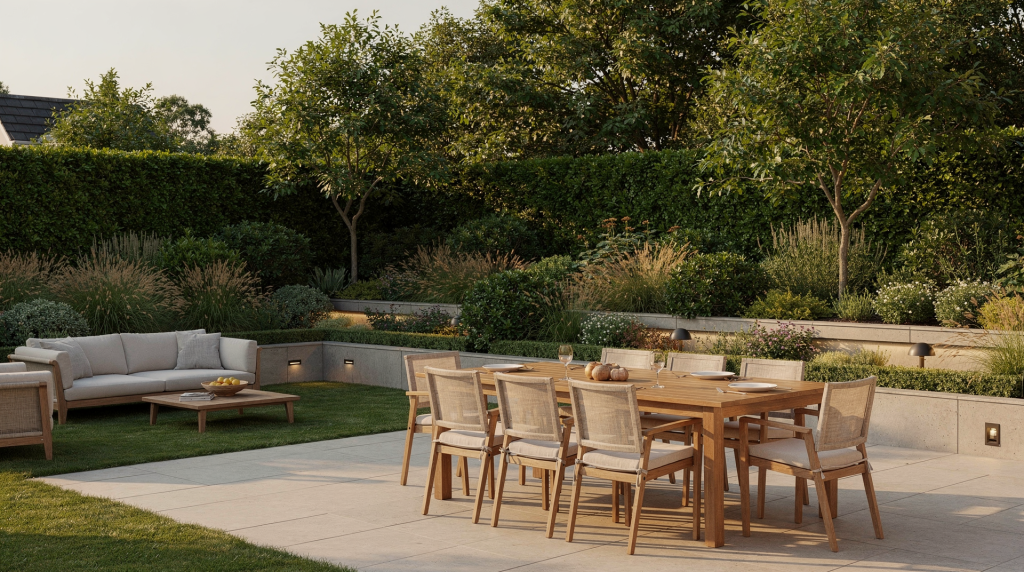
Outdoor dining is never just about placing a table on a patch of grass. It is about shaping a living space where the architecture of the house extends into the garden, and where the rituals of everyday meals and evening gatherings feel as natural outdoors as they do indoors. The most successful entertaining gardens are those where the landscape has been read carefully—where sun, wind, views, and the subtle fall of the land have all been woven into a plan that supports how people actually move, cook, sit, and linger. When it works, you don’t notice the design; you simply stay outside longer, talk more easily, and feel held by the space.
Why outdoor dining design matters
A well-planned entertaining area feels effortless because every element has been thought through from the user’s perspective. The route from kitchen to table, the way a chair scrapes back on stone, the quality of light at seven in the evening—these details determine whether a terrace becomes the heart of daily life or a rarely used afterthought. I’ve seen too many beautifully furnished patios abandoned because the wind funnels through unchecked, or because the table is marooned in full afternoon sun with no shade in sight. Good landscape design solves these problems before they become expensive disappointments.
Outdoor dining also needs to work on two distinct levels:
- Everyday use for family breakfasts, a quiet coffee, or casual suppers—spaces that feel intimate and immediately accessible.
- Occasional hosting for larger groups, longer evenings, and mixed-age gatherings—where flexibility and a sense of occasion come to the fore.
That means the best designs are inherently flexible, comfortable, and visually stitched into the garden rather than fenced off from it. They feel like a natural extension of the home’s living spaces, not a separate outdoor room dropped onto the lawn.
Start with the site, not the furniture
Before you even think about a dining table or a pergola, spend time with the site itself. The strongest outdoor dining spaces are those that respond to the particularities of their setting—the arc of the sun, the prevailing breeze, the view lines that open up or close down. I always advise walking the ground at different times of day, feeling where the light falls and where the wind tugs, before making any fixed decisions. A slight hollow in the land might offer natural shelter; a borrowed view of a distant tree could become the focal point for the whole arrangement.
Check these conditions first
- Sun path: morning sun is a gift for breakfast terraces, but afternoon sun can turn a stone surface into an oven unless shade is planned. Study the seasonal shift—what works in June may be unbearable in August.
- Wind exposure: exposed corners often need hedging, walls, or layered planting to soften gusts. Even a light breeze can make a dinner table uncomfortable, so map the wind’s usual direction.
- Access from the house: the shorter and more direct the route from kitchen or pantry, the more the space will be used. Every extra step is a small friction that, over time, discourages spontaneity.
- View lines: position the table so that guests look toward the garden’s best feature, not the blankest boundary. A carefully framed view can elevate a simple meal into an experience.
- Drainage: a beautiful terrace is frustrating if puddles form after rain. Check how water moves across the site and where it collects; sometimes a subtle regrade or a French drain is the most important design move you’ll make.
A common mistake is designing the dining area in isolation. In practice, outdoor entertaining works best when cooking, serving, dining, and lounging are arranged as related zones—much like an open-plan interior, but with planting and level changes instead of walls.
The ideal layout: zones that flow
Most successful entertaining gardens include three clear areas that relate to one another logically. Guests should be able to drift from one to the next without crossing awkwardly through the middle of a meal or colliding with someone carrying a hot dish. Even in a compact garden, these zones can be defined by a change in surface, a low hedge, or a shift in level.
Recommended planning approach
| Zone | Purpose | Design priority |
|---|---|---|
| Cooking zone | Grill, outdoor kitchen, drinks prep | Easy access, heat-safe surfaces, proximity to the house |
| Dining zone | Main table for meals | Comfort, circulation, shade, lighting |
| Lounge zone | After-dinner conversation | Softer seating, shelter, a more relaxed mood |
If space is limited, combine the cooking and dining functions close to the house, then place the lounge slightly farther away—perhaps under a tree or at the edge of the lawn—for a quieter, more secluded feel. The key is that movement between zones feels intuitive, not like a choreographed obstacle course.
Size the dining area properly
One of the most common planning errors I see is underestimating how much room a table actually needs. The table itself is only part of the equation. Chairs need to pull back, people need to pass behind seated guests, and whoever is serving needs clear access. I often mark out the footprint with string and stakes, then walk around it with a chair to test the clearance. It’s a simple exercise that saves costly mistakes.
Practical space guidelines
- Allow at least 90 cm behind each chair for comfortable movement and pulling out.
- Keep circulation paths clear so people are not stepping around table legs or squeezing past diners.
- Leave an extra margin of hard surface around the dining set—guests shouldn’t have to step onto lawn or planting beds when they rise from the table.
- For a six-person dining setup, think beyond the table footprint: a 3 m × 3 m area is a minimum, but 4 m × 4 m feels generous and relaxed.
A compact terrace can still work beautifully, but it must be carefully proportioned. Cramped dining areas always feel temporary, no matter how fine the materials, because the body never quite settles.
Choosing the right location in the garden
The best dining spot is usually close to the house, but not necessarily pressed against it. You want the convenience of a short walk with a tray, but also the sense of having arrived somewhere distinct—a slight remove that signals a shift in mood. A few steps down a gravel path, a change in paving, or the shadow of a pergola can create that transition.
Good locations include:
- A terrace directly off the kitchen or family room, where the indoor and outdoor floors are nearly flush.
- A sheltered courtyard that captures sun but blocks wind, often created by the L-shape of the house and a garden wall.
- A garden room at the end of a short path, framed by hedging or pleached trees, offering a sense of discovery.
- A raised deck with a view over planting or lawn, which lifts the table into the canopy and changes the perspective.
- A partially enclosed patio framed by walls or hedges, where the enclosure feels protective rather than restrictive.
Locations to avoid unless carefully engineered:
- Low spots with poor drainage, where dampness lingers and furniture feet sink.
- Fully exposed corners with no wind protection, where even a warm day can feel unsettled.
- Areas directly under heavy tree drop—sticky sap, bird droppings, and constant debris make dining a chore.
- Spaces that are visually disconnected from the house and garden, leaving guests feeling marooned rather than immersed.
The sweet spot is nearly always near the home, with just enough separation to feel special—a place you want to walk to, not one you stumble upon by accident.
Shelter, shade, and weather protection
Outdoor dining in an English climate demands flexibility. Even in high summer, a sudden shower or a fierce midday sun can change the mood of a space in minutes. Good shelter extends the season by weeks at either end and makes the area feel reliable—a place you can set a table without anxiously scanning the sky. The shelter itself can become a sculptural element, a piece of land art in miniature: a pergola that casts shifting shadows, a canopy of trained branches that filters light like a living ceiling.
Useful shelter options
- Pergolas for structure and partial shade, especially when clothed in vines like wisteria or grape—they create a room without walls.
- Parasols for movable, adjustable coverage; a crank-and-tilt mechanism lets you follow the sun’s arc.
- Trees for natural canopy and dappled light—a mature mulberry or a well-placed crab apple can anchor the whole composition.
- Awnings for practical rain and sun protection, retractable so the sky can reappear when the weather clears.
- Trellises and screens to create enclosure without closing the space, often softened with climbing roses or jasmine.
A sheltering tree can make a dining area feel intimate and calm, but choose carefully. Avoid species that shed heavily over the table—like sycamore or lime—or those with aggressive roots that will heave paving. The tree should be a companion to the space, not a source of constant maintenance.
Privacy without making the space feel boxed in
Outdoor entertaining works best when guests feel sheltered, not trapped. Privacy should be designed in layers, using living materials that breathe and move, rather than solid barriers that stop the eye dead. I often think of it as creating a series of veils—a transparent hedge here, a screen of tall grasses there—that filter views and sound without severing the connection to the wider garden.
Effective privacy tools
- Mixed hedging—a blend of evergreen and deciduous shrubs that offers year-round structure with seasonal change.
- Pleached trees—limes or hornbeams trained into a high green wall, giving privacy at eye level while leaving the ground plane open.
- Timber screens—horizontal slats or open frameworks that cast linear shadows and support climbing plants.
- Climbing plants on trellis—star jasmine, honeysuckle, or clematis armandii for fragrance and a soft green enclosure.
- Raised planters—filled with billowing perennials or clipped box, they define the edge of the dining area while adding planting at a height you can touch.
- Pergola sides softened with planting—a green wall that doesn’t feel like a wall at all.
The best solutions balance openness and enclosure. A dining terrace benefits from defined edges, but it should still allow glimpses of the garden beyond—a borrowed view of a flowering shrub or a slice of lawn that draws the eye outward.
Materials that suit dining and entertaining
The surface underfoot shapes the whole experience. It affects how the space sounds, how it holds heat, how it feels through the soles of your shoes, and how it weathers over time. In the tradition of land art, I believe the ground plane should be treated as a canvas—its texture, colour, and pattern setting the tone for everything that happens above it. The material must also speak to the architecture of the house, so the terrace reads as an extension of the building rather than an alien insertion.
Strong material choices
- Stone: elegant, durable, and well suited to traditional or country settings. Local stone—York stone, Purbeck, or Cotswold—anchors the terrace in its place and ages gracefully, acquiring a patina of moss and lichen.
- Brick: warm, timeless, and easy to integrate with older houses. A brick terrace laid in a herringbone pattern can feel like a discovered courtyard that has always been there.
- Porcelain paving: practical, low-maintenance, and useful in contemporary gardens. It resists staining and frost, but can feel hard and reflective underfoot; soften it with planting at the edges.
- Gravel: relaxed and atmospheric, with that satisfying crunch underfoot. Less ideal for dining chair legs, but wonderful for linking zones or for a more informal eating area where benches are used.
- Timber decking: useful for level changes and for creating a warm, tactile surface. It needs regular maintenance, but can be the right choice for a raised platform among trees.
Material selection tips
- Choose finishes that sit comfortably with the architecture of the house—a sleek modern extension calls for different textures than a weathered stone cottage.
- Avoid overly polished surfaces that become slippery in wet weather; a light riven or sandblasted finish gives grip without sacrificing refinement.
- Keep materials simple if the planting is already expressive—let the plants be the ornament, and the hard surfaces a quiet backdrop.
- Use one or two main surfaces rather than too many competing textures; a single stone with a gravel border often reads more clearly than a patchwork of different pavers.
A dining terrace should feel like part of the property, not a separate outdoor room dropped onto the lawn. The transition from house to garden should be almost imperceptible underfoot.
Lighting for evening entertaining
Lighting is often treated as an afterthought, yet it transforms the entire usability of the space. Without it, even the most beautiful terrace disappears after sunset, becoming a dark void that no one wants to cross. Good lighting doesn’t just illuminate—it sculpts the night garden, picking out the texture of a tree trunk, the edge of a step, the faces around the table. It should feel like a natural extension of the twilight, not a floodlit stage.
Lighting should do three jobs
- Guide movement along steps and paths—low-level lights that define the route without glare.
- Create atmosphere around the table and seating areas—a warm, intimate glow that encourages people to linger.
- Support practical use for serving, cooking, and clearing up—task lighting that can be dimmed or switched off when the work is done.
Best lighting layers
- Low-level path lights—spaced to create a rhythm, not a runway.
- Wall lights near doors and transitions—subtle, with a warm colour temperature (2700K or lower).
- Soft table or pendant lighting under shelter—a hanging lantern or a cluster of battery-operated candles that pools light on the tabletop.
- Lanterns for flexible mood lighting—moveable, rechargeable, and endlessly adaptable.
- Subtle uplighting for trees or planting—a narrow beam grazing the bark of a multi-stem birch or the seed heads of tall grasses.
Avoid over-lighting the whole garden. The most inviting spaces usually combine a warm central glow with darker edges that preserve intimacy and mystery. Let the garden recede into shadow; it makes the lit table feel like a haven.
Planting around dining areas
Planting does more than decorate the edges. It defines the room, softens hard surfaces, and helps the space feel lived in rather than staged. Near a dining area, plants should be chosen not only for their beauty but for their performance—how they move in the breeze, how they scent the air at dusk, how they catch the low evening light. In a way, they become the walls, the ceiling, and the artwork of the outdoor room.
What planting should do near an entertaining area
- Frame the dining zone—creating a sense of enclosure and focus.
- Filter views without blocking them—a translucent screen of grasses or a light tracery of branches.
- Add seasonal interest—spring blossom, summer fullness, autumn colour, winter structure.
- Provide fragrance, texture, or shade—think of the scent of philadelphus on a June evening, or the rustle of stipa tenuissima.
- Soften walls, fences, and paving edges—blurring the line between built and grown.
Best planting strategies
- Use evergreen structure for year-round presence—yew, box, or osmanthus clipped into simple forms anchor the space even in winter.
- Add loose, seasonal planting for movement and softness—grasses, verbena bonariensis, or gaura that sway and catch the light.
- Place fragrance where guests naturally pass—by a gate, beside a bench, or near the table itself—so it’s encountered as a quiet surprise, not an overwhelming cloud.
- Keep plants slightly back from chair movement zones—allow a buffer of at least 30 cm so that foliage isn’t constantly brushed or broken.
Climbing plants, ornamental grasses, and clipped hedging work especially well near dining spaces because they create a sense of enclosure without visual heaviness. A wall of trained fruit trees—espaliered apples or pears—can be both beautiful and productive, linking the dining table to the garden’s harvest.
Outdoor kitchen, bar, or simple serving station?
Not every garden needs a full outdoor kitchen. The right choice depends on how you actually live and entertain. For some, a simple table with a portable grill is enough; for others, the ritual of cooking outdoors is central to the experience, and a more developed setup makes sense. The key is honesty about how the space will be used, not how it might look in a magazine.
Compare the options
| Option | Best for | Pros | Limitations |
|---|---|---|---|
| Simple dining terrace | Casual meals and occasional hosting | Easy to install, flexible, affordable | Less convenient for full entertaining; cooking often happens indoors |
| Serving station or drinks bar | Social gatherings and lighter use | Compact, useful, low commitment; keeps drinks and snacks outside | Limited cooking function; may still require trips to the kitchen |
| Outdoor kitchen | Frequent entertaining and serious cooking | Highly functional, social, convenient; becomes a hub for the whole garden | Requires more space, budget, and planning; needs weather protection and services |
If the garden is used mainly for relaxed family meals, a good table, shade, and lighting may be enough. If hosting is frequent and cooking is part of the theatre, a more developed cooking zone—with a built-in grill, worktop, and perhaps a sink—is worth considering. Even a small serving station by the back door, with a shelf for glasses and a cool box tucked underneath, can transform the ease of outdoor dining.
Common mistakes to avoid
Even attractive outdoor dining areas can fail if the planning is weak. Over the years, I’ve seen the same errors repeated, and they almost always stem from prioritising looks over use.
The most common errors
- Putting the table in the most exposed part of the garden—where wind and sun make it uncomfortable for all but the calmest days.
- Choosing furniture before understanding the layout—leading to pieces that are too large, too small, or awkwardly placed.
- Underestimating how much circulation space is needed—resulting in cramped, awkward movement.
- Using materials that clash with the house—a sleek white porcelain against a mellow brick cottage, or vice versa.
- Ignoring evening lighting—leaving the terrace dark and uninviting after dusk.
- Forgetting storage for cushions, crockery, and accessories—so the space always looks cluttered or requires a trek to the house.
- Planting too close to chair movement zones—where plants get trampled or guests get scratched.
- Creating a beautiful terrace that is difficult to reach from the kitchen—a long, winding path that discourages spontaneous use.
The easiest way to avoid these problems is to design for use first and decoration second. Walk the routes, test the clearances, and imagine the space in November as well as June.
Step-by-step planning checklist
Use this sequence when designing a dining and entertaining garden. It follows the logic of site first, then layout, then detail—a method that has served me well on projects of every scale.
- Identify the best location near the house, balancing convenience with atmosphere.
- Study sun, shade, wind, and drainage—spend time on site in different conditions.
- Decide how many people the space should serve most of the time, and how many occasionally.
- Mark out dining, cooking, and lounge zones—use string, stakes, or even a hose to define them on the ground.
- Check circulation routes and chair clearance—walk through the space as if carrying a tray.
- Choose materials that suit the architecture and the character of the place.
- Add shelter and privacy where needed, thinking in layers rather than solid barriers.
- Plan lighting before installation, not after—run cables or position solar lights early.
- Place planting to define edges and soften hard surfaces, keeping growth habits in mind.
- Think about storage, servicing, and year-round usability—where will cushions go in winter? How will you clear leaves?
A practical design example
For a typical country house or suburban family home, a strong solution might look like this: a stone terrace laid directly off the kitchen, with the same flooring material continuing from the interior in a slightly riven finish to blur the threshold. A six- to eight-seat dining table sits under a timber pergola, its beams casting a rhythm of shadows across the tabletop. On one side, a hedge of pleached hornbeam screens the neighbouring property while allowing dappled light through its leaves. A small drinks station—little more than a stone-topped console—is tucked by the back door, with a few shelves for glasses and a built-in ice bucket. Low planting of lavender, rosemary, and catmint runs around the perimeter, spilling over the stone edges and releasing scent when brushed. Soft lighting is integrated into the pergola structure—perhaps a string of warm LED festoons—and low path lights lead the way to a secondary seating area a little farther into the garden, where a pair of Adirondack chairs face the sunset. This kind of arrangement feels generous without becoming overcomplicated. It supports weekday breakfasts, summer dinner parties, and quiet evening drinks with equal ease, and it changes character with the seasons—the pergola bare in winter, then clothed in young vine leaves by late spring.
Outdoor dining design: what good looks like
A successful entertaining garden does not announce itself with gimmicks. It feels calm, intuitive, and well balanced. People can move easily, sit comfortably, and stay outside longer because the space has been designed around real use. The best outdoor dining areas usually share the same qualities:
- They are close to the house, with a direct, logical connection to the kitchen.
- They are sheltered but not closed in—protected from wind and excessive sun, yet open to the sky and the garden.
- They have clear movement routes that allow guests and hosts to circulate without obstruction.
- They use durable, attractive materials that age gracefully and feel good underfoot.
- They feel connected to planting and the wider garden—the table is part of the landscape, not isolated from it.
- They work in more than one season, with shelter, lighting, and planting that provide interest and comfort from spring through autumn.
FAQ
How big should an outdoor dining area be?
The space should be large enough for the table, chairs, and comfortable movement around them. As a rule of thumb, allow at least 90 cm behind each chair for pulling out and passing, and aim for a minimum clear area of about 3 m × 3 m for a six-seater table. More generous proportions—4 m × 4 m or beyond—will feel significantly more relaxed and allow for side tables or planters at the edges.
What is the best surface for outdoor dining?
Stone, brick, and high-quality porcelain paving are the most reliable choices for a dining terrace. The best option depends on the style of the house and the level of maintenance you’re willing to undertake. Natural stone offers timeless beauty and a non-slip riven texture; brick feels warm and integrates beautifully with period properties; porcelain is easy to clean and frost-proof, but can feel hard and reflective. Gravel can work for a more informal, bohemian setting, but it’s less practical for chair legs.
Should an outdoor dining area be near the house?
Yes, in most cases. Close access to the kitchen makes the space far more convenient and more likely to be used regularly—for a quick breakfast or an impromptu supper. That said, a short, well-designed path (perhaps 5–10 metres) can create a pleasing sense of transition, turning the dining area into a destination without sacrificing practicality.
Do I need a pergola for outdoor entertaining?
Not necessarily. A pergola helps with shade and structure, and provides a framework for climbing plants, but parasols, trees, awnings, or sheltered walls can also work well. The choice depends on the site’s exposure, the desired atmosphere, and how permanent a structure you want. A large cantilever parasol can be surprisingly effective and can be folded away when not needed.
How do I make an outdoor dining space feel private?
Use hedging, screens, climbing plants, planters, or layered planting to create enclosure without blocking the garden completely. The aim is to filter views and soften boundaries, not to erect a fortress. A combination of a low evergreen hedge, a few pleached trees, and some tall perennials can provide privacy at seating height while still allowing light and glimpses of the wider landscape.
Is outdoor lighting really necessary?
Yes. Good lighting is one of the biggest factors in how often the space is used, especially for evening entertaining. Even a simple arrangement—a pendant light over the table, a few path lights, and a lantern or two—can transform a dark terrace into an inviting room. It extends the usable hours of the garden and creates an atmosphere that no daytime setup can replicate.
Conclusion
Landscape design for outdoor dining and entertaining is about more than styling a terrace. It is about shaping a space that feels comfortable, practical, and welcoming from a sunny lunch through to a starlit supper. When layout, planting, shelter, lighting, and materials work together, the garden becomes a true extension of the house—a place where meals taste better, conversations flow longer, and the boundary between indoors and out dissolves. That is the quiet magic of a well-designed entertaining garden: it doesn’t shout for attention, but it holds you there, happily, hour after hour.