Water, Reflection, and Sound in Residential Garden Design
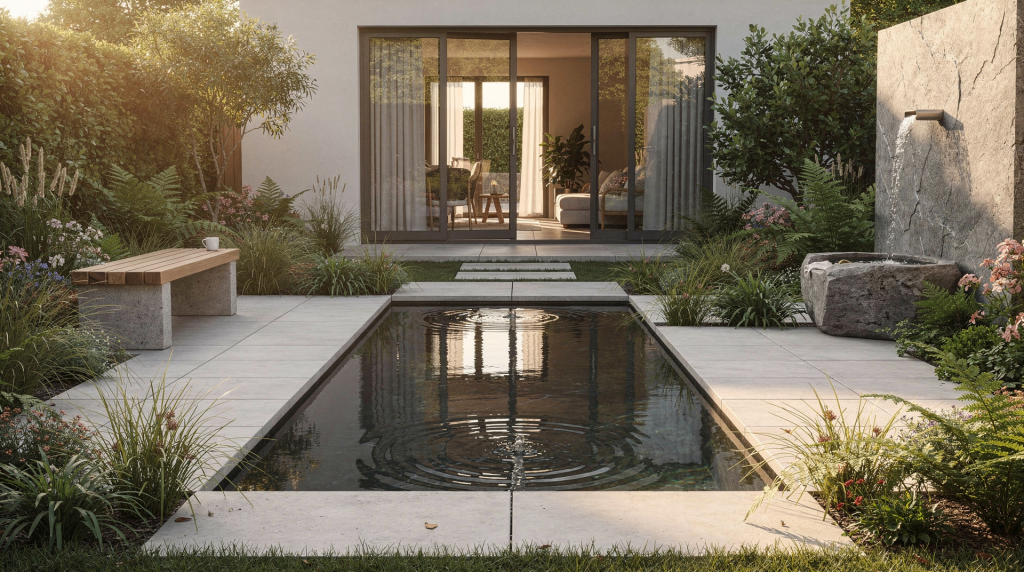
A garden that truly works on the senses rarely relies on planting alone. Water, when handled with restraint and an understanding of how it behaves across the day and through the seasons, brings a layering that few other elements can match. It cools the air on a hot afternoon, catches the low winter sun, and introduces a quality of sound that shifts with the breeze. The trick is to think of water not as an ornament but as a spatial material—something that defines edges, directs the eye, and changes the acoustic signature of a place.
Why water matters in a private garden
In a residential setting, water operates on several registers at once, and the most successful schemes are those where the designer has considered all of them. It is never just a visual gesture.
- Visual: A still surface acts as a second plane, doubling the architecture of the house, the structure of a tree, or the colour of the sky. In a narrow plot, that mirroring can pull the horizon inward and make the space feel significantly larger than its measurements suggest.
- Acoustic: Moving water generates a continuous, layered sound that can soften the jagged edges of traffic noise or distant conversation. It does not cancel unwanted sound so much as weave it into a more tolerable texture.
- Spatial: Water gives the garden a sense of room and threshold. A rill can separate the dining terrace from the wilder planting beyond without a physical barrier; a reflecting pool can anchor a courtyard and give it a calm centre.
That is why a modest rill along a boundary wall or a shallow basin beside a terrace often feels more resolved than a large, freestanding feature that has no clear relationship to the house or the patterns of daily use.
The three roles of water: reflection, sound, and movement
Reflection
A still water surface is essentially a second garden laid flat. It repeats the vertical—walls, trees, sky—and in doing so, it strengthens symmetry and gives small spaces a depth they would not otherwise possess. I have seen a courtyard barely four metres wide feel almost expansive because a narrow reflecting pool ran along one side, carrying the image of a clipped yew hedge and the pale stone of the house into the ground plane.
Best uses for reflection:
- Formal terraces where the architecture demands a strong axial response
- Courtyards that need a sense of openness without sacrificing enclosure
- Walled gardens where the boundary can be visually pushed outward
- Views aligned with house windows or garden doors, so the reflection becomes part of the interior experience
- Narrow plots where every trick of visual expansion counts
Reflection works hardest when the water is calm and the surrounding materials are restrained. A busy planting scheme or a cluttered edge fragments the mirror and turns what should be serene into visual noise.
Sound
The acoustic role of water is often the least understood and the most mishandled. A feature that looks elegant on a plan can, once installed, produce a sound that is either too aggressive for a seating area or too faint to register at all. The goal is usually not to dominate but to create a gentle acoustic veil—something that wraps around the listener and makes the garden feel more private, more removed.
A useful rule: the quieter the garden setting, the softer the water sound should be. In a sheltered seating corner, a low sheet of water slipping over a smooth stone edge will feel refined and restful. A loud cascade in the same spot will feel like an intrusion.
Movement
Movement gives water its liveliness. Ripples catch the low-angle light of morning and evening, breaking the surface into shifting patterns that keep the garden from feeling static. Even a very small feature—a bubbling urn, a narrow channel with a barely perceptible current—can animate an entire space if the movement is well controlled and placed where it catches the eye naturally.
Choosing the right type of water feature
Different features produce different visual and acoustic signatures. The right choice depends on the scale of the garden, the level of maintenance you are willing to accept, and how much sound you actually want to live with day to day.
| Feature type | Best for | Visual effect | Sound effect | Practical note |
|---|---|---|---|---|
| Reflecting pool | Formal gardens, terraces, courtyards | Strong mirror effect | Very quiet | Needs good detailing and regular cleaning |
| Rill or narrow channel | Linear gardens, axis-led layouts | Elegant, directional reflection | Soft flow | Works well alongside walls or paving |
| Fountain | Small to medium gardens | Clear focal point | Noticeable to moderate | Sound depends on drop height and flow |
| Water wall | Contemporary gardens, enclosed spaces | Textured reflection | Continuous sound | Can feel architectural and controlled |
| Cascade | Sloped sites, larger gardens | Dynamic and dramatic | Stronger sound | Can overwhelm small spaces if poorly scaled |
| Bubbling urn or bowl | Small gardens, patios | Compact and decorative | Gentle sound | Easy to place, but often limited in acoustic range |
How to design for reflection
Reflection is not simply about still water. It is about what the water is reflecting, and from where. A pool that mirrors a blank wall offers little; one that captures the facade of the house, the canopy of a mature tree, or a run of tall grasses backlit by the afternoon sun becomes something far richer.
What makes a good reflection
- A flat, calm surface—achieved through sheltered placement and good detailing of the basin edge
- Simple planting nearby, so the reflected image reads clearly rather than dissolving into a green blur
- Strong edges that register in the water: a stone coping, a brick wall, a clipped hedge
- Controlled light; morning and evening light tend to produce the most legible reflections
- A view worth mirroring—the house facade, a sculptural tree, a line of pleached hornbeam
Common mistakes with reflecting water
- Placing a reflective pool where wind constantly disturbs the surface, breaking the mirror into a thousand fragments
- Surrounding it with overly detailed planting that reads as visual clutter in the reflection
- Using dark, muddy water that kills the mirror effect; a dark lining can work, but the water itself must be clear
- Making the pool too small to reflect anything meaningful—a metre-wide basin reflecting only sky is a missed opportunity
- Ignoring the view from inside the house; if the pool is meant to be seen from a living room or kitchen, test the sightline from the main windows before finalising the shape
A good reflection should feel deliberate from the places where people actually sit and look. I always recommend standing at the kitchen window, the sofa, the dining table, and checking what the water catches from each position. If the answer is nothing, the placement needs rethinking.
How to design for sound
Sound is the most site-specific aspect of water design. The same feature can sound completely different depending on the surrounding materials, the enclosure, and the background noise level. This is why listening to a similar installation in person, if possible, is worth far more than any acoustic specification on a drawing.
Start with the sound you want
Ask one simple question: do you want water to be heard as a background murmur or as a clear, identifiable feature?
- Background murmur works well in seating areas, meditation corners, and compact urban gardens where the aim is to soften the edges of the city.
- Clear feature sound suits courtyards, entrance gardens, and places where water is meant to announce itself—a moment of arrival.
What changes the sound
Several design choices affect how water sounds, and small adjustments can make a large difference:
- Drop height: higher drops usually produce a stronger, more percussive sound.
- Surface below: stone, concrete, and other hard surfaces increase audibility and crispness; water falling onto gravel or planting sounds softer and more diffused.
- Flow rate: more flow generally means more presence, but beyond a certain point it can become monotonous or overwhelming.
- Basin shape: a deeper or more enclosed basin can make the sound feel fuller and more resonant.
- Nearby walls: reflective surfaces bounce sound forward and can increase the sense of presence, which is useful in some spots and problematic in others.
Where sound helps most
Water sound is especially useful in:
- Urban gardens with road noise that needs softening
- Terraces near neighbours where a gentle acoustic screen adds privacy
- Courtyards with hard boundaries that would otherwise feel acoustically harsh
- Side gardens that feel exposed or overlooked
- Seating areas that need a gentler, more introspective atmosphere
Placement: where water works best in the garden
Placement matters as much as the feature itself. A well-chosen water element in the wrong spot will never feel settled.
Good locations
- Between the seating area and the noise source, so the water acts as an acoustic buffer
- Near a wall or fence that helps direct and contain the sound
- At the end of a view line from the house, where the eye naturally travels and the water becomes a visual full stop
- In a corner where both reflection and acoustics can be contained and amplified
- Beside a terrace where the water becomes part of daily life—heard during morning coffee, seen from the dining table
Poor locations
- In the middle of a windy open lawn, where the surface will rarely be still
- Too close to bedroom windows if the sound is strong enough to disturb sleep
- Where splash will wet paving, furniture, or doors, creating maintenance headaches
- In a spot that cannot be seen from the main living spaces, reducing the feature to something you only encounter when you make an effort
- Where maintenance access is awkward—if you cannot reach the pump or clean the basin easily, the feature will deteriorate
A simple test: stand where you expect to sit and listen to the garden without the water running. Note the quality of the silence or the nature of the background noise. Then imagine whether the feature will improve that experience or simply add another layer of sound you do not need.
The role of materials
Materials shape both reflection and sound, and in practice, the surrounding finishes often matter as much as the water itself. The choice between stone and gravel, between a hard edge and a planted margin, changes everything about how the water reads.
Hard materials
Stone, concrete, brick, and metal increase clarity and definition. They help reflect light into the water, reinforce sound, and give the feature a sharper architectural character. A limestone coping around a reflecting pool, for instance, will read as a crisp frame, especially when the low sun catches its edge.
Softer materials
Planting, gravel, and dense borders absorb more sound and soften the visual effect. They help reduce harshness, make the water feel more natural, and keep the garden from becoming overly formal. A rill running through a gravel garden with grasses spilling over its edges feels entirely different from one set into a paved terrace.
Best combinations
- Stone + still water for refined reflection and a sense of permanence
- Concrete + sheet flow for modern, architectural gardens where the water reads as a plane
- Brick wall + fountain for warm, enclosed courtyards with a Mediterranean feel
- Planting + narrow rill for quieter, softer movement that feels integrated into the garden rather than imposed upon it
Water in different garden styles
Formal gardens
Use symmetry, straight lines, and still water. Reflection becomes the main event. A long rectangular pool aligned with the house’s central axis, flanked by clipped box or yew, creates a sense of order that feels both calm and grand.
Contemporary gardens
Use simple geometry, crisp edges, and controlled sound. Water should feel integrated into the architecture rather than added on. A sheet of water sliding over a dark concrete plinth, for example, reads as part of the building’s language.
Naturalistic gardens
Use subtle movement, shallow channels, or small pools tucked into planting. The goal is not a mirror-perfect surface but a sense of living water—something that feels as though it has always been there. A shallow scrape in the earth lined with clay and fed by a gentle inflow can be more evocative than any formal basin.
Courtyard gardens
Use compact features that balance privacy and atmosphere. In small enclosed spaces, a little water goes a long way. A single bubbling bowl in a corner, or a narrow water wall against a boundary, can transform a courtyard from a light well into a room.
Step-by-step: planning a water feature for a residential garden
1. Define the purpose
Decide whether the feature is mainly for reflection, sound, or both. This single decision shapes everything that follows.
2. Study the site
Check sunlight, wind, views from the house, and the direction of existing noise. Spend time on site at different times of day. A spot that seems perfect at noon may be in deep shadow by mid-afternoon, or exposed to a prevailing wind that will ruffle the surface constantly.
3. Choose the scale
Match the feature to the size of the garden. A large cascade in a small courtyard usually feels wrong—not just visually, but acoustically. The sound will dominate and the feature will read as an imposition rather than an invitation.
4. Select materials
Choose finishes that support the mood you want: calm, formal, contemporary, or natural. The material palette should extend from the house into the garden, so the water feature feels like a continuation of the architecture rather than a separate object.
5. Test the sound
If possible, listen to similar features before committing. Sound is hard to judge from drawings alone. The difference between a gentle murmur and an irritating splash can be a matter of millimetres in drop height or a slight change in the surface below.
6. Plan maintenance
Think about cleaning, pump access, evaporation, leaf fall, and winter use. A feature that is beautiful in summer but becomes a stagnant, leaf-filled eyesore in autumn is not a successful design.
7. Refine the edges
Good detailing at the boundary between water, paving, and planting makes the whole design feel resolved. The way the water meets the stone, the shadow line of the coping, the transition from wet to dry—these are the details that separate a considered feature from an afterthought.
Maintenance realities
Water features look effortless only when they are properly maintained. Neglect shows quickly: a green tinge to the water, a clogged pump, a rim of mineral deposits along the edge. The most beautiful reflecting pool becomes a liability if the surface is never still and the water never clear.
What needs attention
- Algae and debris that cloud the water and clog the pump
- Pump cleaning and occasional replacement of worn parts
- Water level changes from evaporation, especially in hot, dry weather
- Leaf fall in autumn, which can quickly blanket a still surface and stain the basin
- Frost protection in colder months, particularly for pumps and exposed pipework
- Mineral staining on stone or concrete, which can leave a white tidemark if not addressed
Simple maintenance checklist
- Check water level weekly in dry weather and top up as needed
- Remove debris before it sinks and begins to decompose
- Inspect the pump regularly and clean the intake screen
- Clean edges and basins before buildup becomes stubborn
- Review sound output after cleaning, since dirt and debris can change the acoustic performance significantly
Common mistakes to avoid
- Designing for looks alone and ignoring sound—what photographs well may be unpleasant to live with
- Choosing a feature that is too large for the space, visually or acoustically
- Placing reflective water where wind destroys the surface, turning a mirror into a distraction
- Creating a loud feature next to a quiet seating area, where it will feel intrusive rather than soothing
- Using too many competing materials, which fragments the design and weakens the impact of the water
- Forgetting access for cleaning and repairs—if you cannot reach it, you will not maintain it
- Treating water as a decorative object instead of part of the garden structure; it should feel inevitable, not applied
A simple decision guide
| Goal | Best water strategy |
|---|---|
| Make a garden feel larger | Use still water and strong reflections |
| Soften traffic noise | Use moving water with a controlled sound level |
| Create a calm seating area | Choose a quiet fountain or shallow rill |
| Add drama to a formal layout | Use symmetry and a clear reflective axis |
| Improve a compact courtyard | Use a small but well-placed feature with hard surrounding surfaces |
Conclusion
Water, reflection, and sound work best in residential garden design when they are shaped around the way people actually use the space. A successful feature is not simply beautiful to look at; it improves the atmosphere, supports the architecture, and makes the garden feel more complete. When reflection, acoustics, materials, and placement are considered together, even a modest water feature can transform a private garden into a more restful and memorable place. The key is to treat water as a material of space-making, not as decoration—and to listen as carefully as you look.
FAQ
What is the best water feature for a small garden?
A small reflecting pool, narrow rill, or compact fountain usually works best because it adds atmosphere without overwhelming the space. In a very small courtyard, a single water bowl or a short water wall can provide both reflection and a gentle acoustic presence without consuming valuable floor area.
How do I make a water feature sound softer?
Lower the drop height, reduce turbulence, and use a calmer flow over a smooth surface. Changing the material the water falls onto—from stone to a bed of pebbles, for instance—can also soften the sound considerably.
How do I make water reflection stronger?
Keep the surface calm by sheltering the pool from wind, simplify the surroundings so the reflected image reads clearly, and place the feature where it mirrors something visually strong, such as the house facade, a mature tree, or a run of structured planting.
Can water features reduce noise?
Yes, moving water can help mask unwanted background noise by creating a more continuous and pleasant soundscape. It does not eliminate noise but weaves it into a less intrusive acoustic texture, which can make a garden feel significantly more peaceful.
Do water features need a lot of maintenance?
Most do require regular care, especially cleaning, pump checks, and seasonal upkeep. The more reflective or technically complex the design, the more attention it usually needs. A simple bubbling urn may need little more than occasional topping up and cleaning, while a large reflecting pool with a hidden overflow system demands consistent monitoring to keep the surface pristine.