Choosing Materials for Paths, Terraces, and Garden Walls
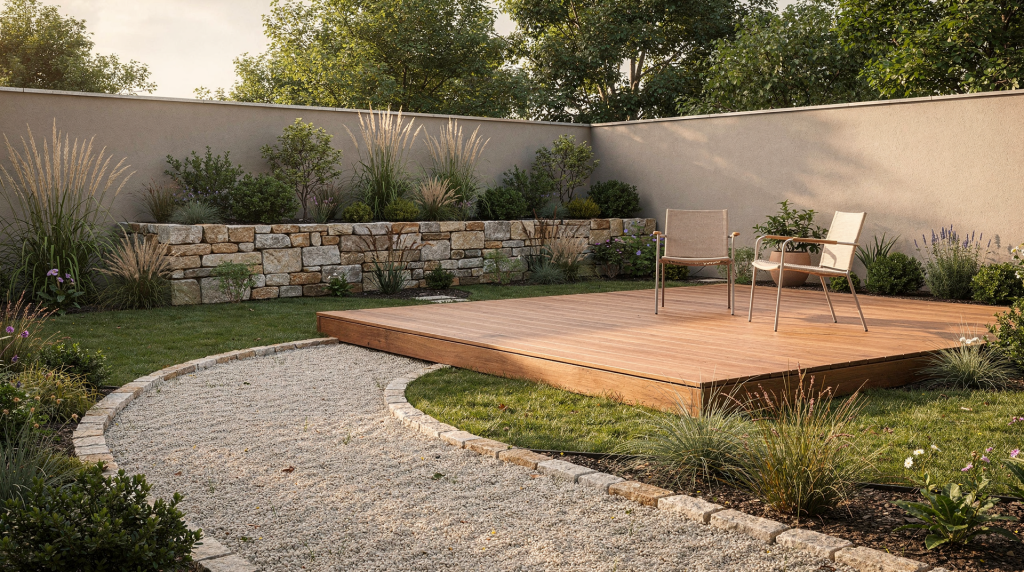
I’ve walked enough gardens to know that the materials underfoot tell you everything about how a space will age. The right hard landscaping doesn’t just finish a garden — it shapes how the space feels, how easy it is to use, and how well it performs through wet winters, dry summers, and years of wear. In a residential setting, paths, terraces, and walls should work together as one system: visually coherent, structurally sound, and suited to the way the garden is actually lived in.
What follows is drawn from years of documenting private gardens across the UK, watching how materials behave over time, and learning which choices quietly succeed and which fail loudly. If you’re planning a new scheme or replacing tired paving, this guide will help you choose materials that look right and last.
Start with function, not finish
I’ve seen too many projects where the stone was chosen first and the practical questions asked later. That’s backwards. Before you think about colour, texture, or whether something photographs well, define what each area needs to do.
- A main route to the front door, bin store, shed, or side return needs a firm, safe surface — one that won’t become treacherous in November or rut under a wheelbarrow.
- A terrace or seating area needs comfort underfoot, good drainage, and a finish that works with furniture. Chairs shouldn’t wobble, tables shouldn’t sink, and you shouldn’t be ankle-deep in puddles after a summer shower.
- A garden wall may need to retain soil, define a boundary, create privacy, or simply give structure to planting. Each function demands a different structural approach.
The biggest mistake I encounter is selecting materials by appearance alone. A beautiful surface that becomes slippery, unstable, or expensive to maintain will quickly feel like a poor decision — and it will look worse with every passing season.
The best materials for garden paths
Paths should guide movement, stay level, and cope with foot traffic in all seasons. In the UK, the most useful path materials usually fall into five groups, each with its own character and practical limits.
| Material | Best for | Strengths | Limitations |
|---|---|---|---|
| Gravel | Informal paths, side passages, cottage gardens | Affordable, permeable, soft visual texture | Needs containment, can migrate, less suitable for wheelchairs or pushchairs |
| Brick | Formal routes, period gardens, courtyards | Warm colour, attractive pattern options, good character | More labour-intensive, can be slippery if poorly detailed |
| Natural stone | Main garden routes, terraces, premium landscapes | Durable, timeless, rich texture | Higher cost, quality varies by stone type |
| Concrete paving | Practical family gardens, busy circulation areas | Reliable, consistent, often cost-effective | Can look generic if detailing is weak |
| Resin-bound aggregate | Contemporary designs, accessible paths, curved routes | Smooth, permeable, low maintenance | Needs proper installation and a stable base |
Gravel: the most forgiving option for informal gardens
Gravel works well where the garden should feel relaxed, quiet, and slightly loose in character. There’s something deeply satisfying about the sound of footsteps on gravel — it announces arrival, slows the pace, and suits paths through planting, around country houses, and in areas where permeability matters. A compacted gravel path with proper edging is often the most practical answer for secondary routes.
Use it when:
- you want a softer, more natural look;
- drainage is important;
- the path is not required to support furniture or frequent wheeled traffic.
Avoid it when:
- the route must be fully accessible;
- children will regularly run over it;
- you want a crisp, architectural finish.
A good gravel path depends on edges. Without them, it spreads, ruts, and looks unfinished within a season. Choose a stone size that locks reasonably well underfoot — angular chippings rather than rounded pebbles — and keep the layer depth controlled. Too deep, and it becomes a chore to walk on; too shallow, and the membrane beneath shows through.
Brick: ideal where you want warmth and pattern
Brick gives a path rhythm and character. It works especially well in older properties, enclosed courtyards, and gardens where the architecture already uses brick. Reclaimed brick can be especially effective because its colour variation softens hard edges and makes the path feel settled rather than newly laid.
Useful brick path patterns include:
- herringbone, for strength and movement — it resists shifting better than simpler bonds;
- stretcher bond, for a calmer and simpler look;
- basket weave, for smaller or more traditional spaces where you want texture without busyness.
Watch for:
- slippery surfaces if the brick is too smooth — engineering bricks can be treacherous when wet;
- poor sub-base preparation, which leads to movement and uneven settling;
- mismatched new and reclaimed stock without a considered layout — the eye catches inconsistency quickly.
Natural stone: the most adaptable premium choice
Stone is the best all-round material when you want longevity and a more permanent feel. It can be calm and minimal, or richly textured, depending on the finish. In the UK, local stone often gives the most convincing result because it sits naturally within the landscape and architecture — it belongs, rather than being imposed.
Stone works best where:
- the path is part of the main composition;
- the garden connects directly to the house;
- you want material continuity between steps, terraces, and walling.
The main decision is not just the stone type, but the finish. Sawn stone feels crisp and contemporary — it suits modern houses with clean lines. Tumbled or riven stone reads as more traditional and relaxed, its surface catching light and shadow in a softer way. For wet climates, choose a finish that provides enough grip without looking rough or overworked. A lightly textured sawn finish often strikes the right balance.
Concrete paving: practical, but detail matters
Concrete paving is often the best option for a tight budget or a highly used route. It can be neat, robust, and straightforward to install. The risk is visual dullness — I’ve seen concrete paths that feel like an afterthought, and others that feel considered and architectural. The difference is almost always in the detailing.
Large-format units with carefully aligned joints usually look better than small, busy layouts. Concrete paving is most successful when:
- the colour palette is restrained — grey, buff, or softly toned;
- the edges are sharp and well resolved;
- the paving is paired with planting that softens its appearance, letting foliage spill over the edges.
Choosing the right terrace material
A terrace is different from a path. It is a room without walls, a place for tables, chairs, and day-to-day living. Comfort matters as much as appearance. When I photograph terraces, I notice how people naturally gravitate toward surfaces that feel stable and welcoming — and avoid those that feel hard, cold, or precarious.
What a terrace material must do
A good terrace surface should:
- feel stable under furniture — no wobbling chairs or sinking table legs;
- drain quickly after rain — standing water kills the mood faster than anything;
- resist slipping — especially important where the terrace meets the house;
- complement the house facade — the terrace is the transition between indoors and out;
- age gracefully rather than just wear out — some materials improve with time, others simply degrade.
Best terrace materials for UK gardens
Stone paving
Stone is the classic terrace material because it balances formality and ease. It bridges the house and garden well, especially where exterior paving needs to feel like an extension of interior flooring. I’ve seen this done beautifully when the same stone runs from kitchen to terrace, blurring the boundary.
Choose it when:
- the terrace is close to the house;
- you want a refined, permanent finish;
- the garden needs a sense of continuity.
Porcelain paving
Porcelain is popular in contemporary gardens because it offers clean lines, consistent colour, and a low-maintenance surface. It is especially useful where staining and cleaning are concerns — red wine, barbecue grease, and autumn leaves leave no trace.
Choose it when:
- you want a modern look;
- the terrace sees heavy use;
- minimal maintenance is a priority.
Be careful not to make the whole space feel too hard or sterile. Porcelain needs planting, timber, or softer textures nearby to avoid looking overdesigned. I’ve seen terraces that feel more like a showroom than a garden — the best ones always have plants breaking the edges.
Gravel terraces
Gravel can work for informal terraces, but only in specific settings. It suits larger rural gardens, low-key seating zones, and spaces where a relaxed atmosphere matters more than crisp definition. The crunch underfoot becomes part of the experience.
It is less suitable when:
- chairs need to sit level;
- guests will move easily from inside to outside;
- you want a polished entertaining space.
Brick terraces
Brick is a strong choice for terraces in period houses, barns, and townhouse gardens. It adds texture and works well with planting that has structure and seasonal movement. The warmth of brick under low autumn light is one of those quiet pleasures that makes a garden feel inhabited rather than just designed.
Drainage: the detail that decides long-term success
Good materials fail when drainage is ignored. In the UK climate, water management is not optional — it’s the difference between a surface that lasts twenty years and one that fails in five.
For paths
- Use permeable surfaces where possible — they reduce runoff and puddling.
- Make sure water does not sit against buildings — damp walls and foundations are expensive to fix.
- Use a stable sub-base and sensible falls — even a slight gradient moves water effectively.
- Contain loose surfaces with proper edging — gravel paths without edges become gravel everywhere.
For terraces
- Build in a slight fall away from the house — 1:60 to 1:80 is usually sufficient.
- Avoid flat surfaces that collect standing water — they look innocent until the first heavy rain.
- Match the paving system to the site, not the catalogue image — what works on a showroom floor may fail on heavy clay.
- In clay-heavy or wet sites, think carefully about sub-base and outlet design — water needs somewhere to go.
Simple rule
If the material does not naturally drain, the structure beneath it must do the work. This is the principle that separates lasting installations from temporary ones.
How to choose materials for garden walls
Garden walls do more than retain soil. They set boundaries, create rooms, support levels, and give a garden architectural weight. The right material depends on whether the wall is decorative, structural, or both. I’ve learned to read walls as the skeleton of a garden — they hold the space together even when planting is sparse.
Common wall materials
| Material | Best for | Strengths | Limitations |
|---|---|---|---|
| Natural stone | Retaining walls, feature walls, historic settings | Durable, elegant, timeless | Costly, heavier, needs good detailing |
| Brick | Boundary walls, formal gardens, house-adjacent walls | Cohesive with many UK homes, versatile | Less suited to very exposed retaining work without proper build-up |
| Concrete block with face finish | Structural retaining walls, hidden substructure | Strong, economical, adaptable | Needs cladding or facing for visual quality |
| Engineering brick | Exposed, weather-heavy locations | Very durable, reliable in demanding conditions | Can feel plain if used without care |
| Gabions | Contemporary retaining or screening | Draining, robust, visually strong | Bulky, industrial look, not for every garden |
Stone walls
Stone is the most atmospheric choice if the garden should feel rooted in place. It suits rural properties, older houses, and landscapes that benefit from texture and permanence. A well-built stone wall looks like it grew there.
Dry stone walling is especially effective where drainage matters and a softer, rural character is wanted. The gaps between stones allow water through and create habitats for wildlife. Mortared stone is better when the wall needs precision and structural certainty — for retaining significant loads or creating crisp architectural lines.
Brick walls
Brick works well when the house itself is brick or when the garden design needs warmth and order. It can be formal, understated, or rustic depending on the bond and finish. The key is matching the brick to the context — a harsh new brick in a weathered setting will always look wrong.
Brick is especially useful for:
- boundary walls near the house;
- raised planters;
- low retaining walls;
- garden rooms with a defined architectural character.
Concrete block walls
Concrete block is often the most sensible structural choice where the wall will be faced or rendered. It is not the pretty part of the wall, but it is often the part that makes the project work properly. Think of it as the skeleton beneath the skin.
Use it for:
- retaining structures;
- walls where strength matters more than appearance;
- situations where the visible finish will come later — stone cladding, render, or timber facing.
Gabions
Gabions are practical for retaining and for contemporary landscapes. They drain naturally and can be very durable. They suit modern rural plots, steep sites, and gardens that can tolerate a bolder, more industrial expression. I’ve seen them used brilliantly in converted agricultural settings, where their utilitarian character feels honest rather than forced.
They are less successful when the garden needs softness or delicacy — a cottage garden with gabion walls feels like a contradiction.
Matching materials to house style
The best gardens feel connected to the house. The materials don’t need to match exactly, but they should be in conversation. When I photograph a garden that works, there’s always a visible thread between the architecture and the hard landscaping.
- Brick house: brick paths, brick or stone terraces, brick boundary walls. The warmth carries through.
- Stone house: natural stone paving and walling, with gravel for secondary circulation. Let the local geology set the tone.
- Modern house: large-format stone, porcelain, rendered blockwork, and restrained detailing. Clean lines, minimal joints.
- Country house: gravel, reclaimed brick, local stone, and dry stone or mortared walling. Materials that look settled, not new.
The aim is not perfect matching. It is material conversation. Too much sameness looks flat — everything blends into everything else. Too many competing finishes look chaotic — the eye has nowhere to rest. The sweet spot is a limited palette where each material has a clear role.
A practical selection process
Use this sequence when planning a project. I’ve found it keeps decisions grounded and prevents expensive impulse choices.
- Define the function of each area — what happens here, and when?
- Check how wet, shady, exposed, or sloping the site is — these conditions dictate what will survive.
- Decide whether the material should be formal or informal — this shapes the whole atmosphere.
- Match the finish to the house and surrounding landscape — look at what’s already there.
- Check maintenance tolerance honestly — will you really seal that stone every year?
- Confirm drainage, edging, and sub-base requirements before ordering — the hidden layers matter most.
Common mistakes to avoid
I’ve seen these errors repeated across gardens of every scale and budget. They’re easy to make and expensive to fix.
- Choosing a slippery finish for a frequently used terrace — it’s dangerous and stressful.
- Using loose gravel without proper edges — it becomes a mess within months.
- Mixing too many paving types in one small garden — the space fragments visually.
- Building a wall without considering drainage behind it — pressure builds, and walls fail.
- Prioritising colour over performance — a pretty surface that fails is just expensive regret.
- Ignoring how materials will weather over time — some improve, others deteriorate.
- Using a decorative finish where a structural solution is needed — style cannot substitute for strength.
A quick checklist before you buy
Run through these questions before committing to any material. They’ve saved me from poor decisions more than once.
- Does the material suit the climate?
- Will it work in wet weather?
- Is it appropriate for foot traffic or furniture?
- Does it need sealing, regular topping-up, or cleaning?
- Will it age attractively?
- Does it belong to the architecture of the house?
- Is the base specification realistic for the site?
Final thoughts
The best paths, terraces, and garden walls are rarely the flashiest. They are the ones that quietly support daily life while making the whole garden feel coherent. In practice, that usually means choosing materials that suit the house, the soil, the weather, and the way the space will actually be used — not just how it looks in a photograph.
If in doubt, start with durability and drainage, then refine the visual finish. A material that performs well will always look better in the long run than one that only looks good on day one. Time has a way of revealing which choices were wise and which were merely fashionable.
FAQ
What is the best low-maintenance material for a garden terrace?
Porcelain is one of the easiest terrace materials to keep clean — it resists staining and needs little more than occasional washing. Natural stone is often the best balance of durability and character, developing a patina that improves with age rather than just wearing out.
Is gravel a good choice for garden paths?
Yes, for informal or secondary paths. It is affordable and permeable, but it needs edging and is less suitable for accessible routes. The crunch underfoot is part of its charm, but it’s not the right choice for every situation.
What is the most durable material for garden walls?
Natural stone and engineering brick are both highly durable, while concrete block is often the strongest structural core when faced properly. The key is matching the material to the conditions — exposure, load, and moisture all play a role.
Can I mix different path materials in one garden?
Yes, and often you should. The key is to limit the palette and give each material a clear role. A garden with one surface throughout can feel monotonous; a garden with too many feels restless. Aim for two or three materials that relate to each other and to the house.
Do retaining garden walls need drainage?
Yes. Retaining walls must manage water behind them, or pressure can cause movement and failure. This is not optional — it’s one of the most common causes of wall collapse in domestic gardens. Weep holes, drainage gravel, and proper backfill are essential.