How to Design a Low-Maintenance Garden Around a Private Home
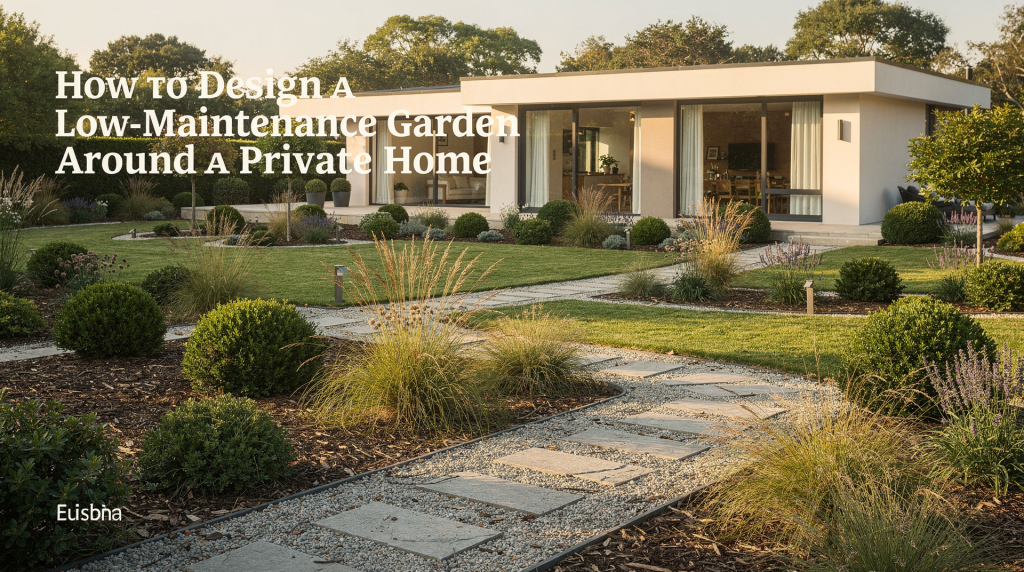
A low-maintenance garden is not a garden with no work at all. It is a landscape designed to reduce repetitive jobs, simplify seasonal tasks, and keep the space looking intentional with less effort over time. The best results come from getting the layout, planting, and surfaces right from the start.
What “low-maintenance” really means
In practice, low-maintenance design is about reducing the jobs that never end: mowing, edging, weeding, deadheading, staking, watering, and replacing plants that were never suited to the site in the first place. The goal is not to strip the garden of character, but to make every element earn its place.
A well-planned garden around a private home should feel calm and coherent. That usually means fewer plant varieties, stronger structure, better soil preparation, and hard landscaping that does some of the work for you. When I walk onto a terrace that extends the interior flooring material—say, the same stone running from the kitchen out to the seating area—the boundary between inside and outside softens. The garden becomes another room, not an afterthought. Achieving that requires discipline: every path, every bed, every tree must justify its presence, not just look good in a catalogue.
Start with how you actually live
Before choosing plants or paving, look at how the garden will be used.
- Do you want a place to sit outside in summer?
- Is the garden mainly seen from the house?
- Do children or pets need open space?
- Do you need access routes to bins, sheds, or side gates?
- How much time do you realistically want to spend maintaining it?
A low-maintenance design only works if it matches the household. A family that wants outdoor dining, play space, and a little greenery needs a different solution from a couple who want a quiet, elegant setting with minimal upkeep. I often see gardens where the owners’ habits fight the layout—a washing line strung across a prized border, a barbecue marooned on a patch of grass that turns to mud. The garden should absorb daily life without looking messy, and that starts with honest answers to these questions.
A simple way to define priorities
Use this quick ranking exercise:
- List the functions the garden must serve.
- Mark the features you want but can compromise on.
- Remove anything that creates repeated maintenance without adding real value.
- Keep the strongest ideas and design around them.
This is where many gardens become easier to live with: not by adding more features, but by removing clutter. I’ve watched clients struggle to let go of a rose arch that needed constant tying-in, only to realise the space breathed better without it. The most enduring gardens around private homes are often the simplest—a few bold moves rather than a collection of small gestures.
Build the layout around zones
The most efficient low-maintenance gardens are usually divided into clear zones. This isn’t just about practicality; it’s about how the eye travels from the house. When you look out from the living room, the foreground should feel like an extension of the architecture—clean, usable, composed. Middle distance can hold softer planting, and the boundaries recede into evergreen structure. Zoning makes that hierarchy legible.
1. House zone
This is the area closest to the home: terrace, seating, doors, and circulation. It should be the easiest part of the garden to use and maintain. Materials here matter enormously: a limestone paving that echoes the façade, or timber decking set at the same level as the interior floor, blurs the threshold. Keep this zone uncluttered; a couple of large containers with structural evergreens are often enough.
2. Utility zone
This may include compost, storage, bins, washing lines, or a potting area. Keep it practical and visually quiet. A screen of pleached hornbeam or a simple slatted fence can hide bins without creating a dark corner. The utility zone shouldn’t be an eyesore you apologise for—it should be a working part of the garden, tucked away but still considered.
3. Planting zone
This is where the garden does its softening and seasonal work. Make it large enough to look intentional, but not so fragmented that it becomes fiddly. A single generous border along a boundary, planted in repeating blocks, reads far better than several tiny beds dotted around the lawn. The planting zone is also where you can introduce the rhythms of land art: massed grasses that ripple in the wind, or a sweep of perennials that change colour through the season, anchored by a few sculptural shrubs.
4. Low-use or edge zone
Corners, boundaries, and awkward strips can be used for evergreen structure, screening, or tough groundcover instead of high-input planting. Here, think of plants that do a quiet job year-round: Vinca minor, Pachysandra, or a carpet of Waldsteinia. They stabilise the soil, suppress weeds, and ask for almost nothing.
Clear zoning reduces random tasks. It also makes maintenance faster because every part of the garden has a purpose. When you walk out with secateurs, you know exactly where to go.
Reduce lawn area first
If there is one decision that immediately lowers maintenance, it is reducing grass.
Grass looks simple, but it is often the most demanding part of a garden. It needs mowing, edging, feeding, occasional scarifying, weed control, and water in dry spells. If the lawn is small and awkwardly shaped, it usually creates more work than value. I’ve seen countless gardens where the lawn is a leftover shape—a jagged remnant between paths and borders—and it becomes a weekly frustration. A lawn should be a deliberate, geometric element, not an afterthought.
Better alternatives to a large lawn
- A larger terrace or paved sitting area
- Gravel with planted edges
- Groundcover planting
- Meadow-style grass in a limited, less formal strip
- A simple rectangular lawn rather than multiple curves and cut-ins
If a lawn is still important, keep it:
- square or rectangular
- easy to mow in straight lines
- free from tight corners
- bordered with clean edges rather than complicated curves
A simple lawn is manageable. A fussy one becomes a weekly chore. When I photograph gardens where the lawn is a calm green rectangle framed by stone edging, it feels like a piece of the architecture—a living plinth for the house. That’s the kind of lawn worth keeping.
Use hard landscaping to do more of the work
Hard landscaping is your best ally in a low-maintenance garden. Paths, patios, steps, edging, and retaining elements can reduce mowing, suppress weeds, and make the whole garden easier to navigate. But beyond function, these surfaces set the tone. The choice of material—whether it’s sawn York stone, clay pavers, or crisp gravel—creates a dialogue with the house. A modern home with large glazing demands a different surface language than a weathered stone cottage.
Surfaces that reduce maintenance
- Paving for terraces and main routes
- Gravel for side paths and informal circulation
- Decking where a raised or lightweight solution is needed
- Porous or well-drained surfaces where water management matters
- Defined edging to stop grass and borders merging
The key is moderation. Too many materials can make a garden feel busy. Use fewer, better-placed surfaces rather than mixing everything at once. A single palette of stone and gravel, repeated from front to back, creates a quiet backdrop that lets planting take centre stage.
Good hard landscaping habits
- Keep paths wide enough to use comfortably—1.2 metres minimum for two people to walk side by side
- Avoid decorative shapes that complicate upkeep; a straight path with a simple joint pattern is easier to maintain than a curving one with intricate cuts
- Use durable edging so borders do not collapse into paths; steel or stone edging gives a clean line that lasts decades
- Make access practical for wheelbarrows, mowers, and maintenance tools; a narrow, winding path becomes a bottleneck
Choose the right planting strategy
Low-maintenance planting is not about buying “easy” plants from a list and hoping for the best. It is about choosing plants suited to the site, then arranging them so they support each other. The most successful schemes I’ve documented work because the plants form a community: the ground layer shades out weeds, the middle layer provides seasonal interest, and the structural layer holds the composition together through winter.
What makes a plant low-maintenance?
A plant is usually easier to live with if it:
- suits the soil and light levels
- is hardy in the local climate
- does not need staking
- does not require frequent deadheading
- does not need winter protection
- keeps a good shape without constant pruning
There is no truly maintenance-free plant. But some plants need very little once established. A well-sited Amelanchier lamarckii, for instance, offers spring blossom, summer berries, and autumn colour with almost no intervention. That’s the kind of plant that earns its place.
Design principles for easier planting
- Repeat a small number of plant types rather than using too many varieties
- Use evergreen structure for year-round form
- Plant in groups rather than as isolated specimens
- Match plants to moisture levels, so everything in one area wants similar care
- Choose long-lived shrubs and perennials instead of tender bedding plants
A simple, repeated planting scheme usually looks more confident than a patchwork of one-off choices. When you stand at the kitchen window and see the same grass, the same shrub, the same perennial block repeated along the boundary, the garden feels composed. It’s a principle borrowed from large-scale landscape design, scaled down to the private realm.
A practical planting formula
A reliable low-maintenance border often combines three layers:
- Structural layer: evergreen shrubs or small trees
- Seasonal layer: hardy perennials with long flowering periods
- Ground layer: mulch, gravel, or dense groundcover to suppress weeds
This structure gives the garden form even when flowers are not at their peak. In winter, the evergreens carry the space; in summer, the perennials fill in. It’s a rhythm that works with the seasons rather than against them.
Easy-care planting types to consider
- Hardy shrubs that hold shape well, such as Pittosporum, Choisya, or Viburnum
- Ornamental grasses for movement and texture: Calamagrostis, Miscanthus, Stipa
- Tough perennials that return reliably: Geranium, Salvia, Echinacea
- Small trees with tidy crowns: Amelanchier, Cercis, Malus
- Evergreen plants for winter structure: Taxus, Ilex, Osmanthus
Avoid designs that depend heavily on annual bedding, tender exotics, or plants that must be lifted, staked, or replaced each year. Those are the gardens that look glorious for a few weeks and then demand a rescue mission.
Mulch is not optional
Bare soil is where a lot of garden maintenance begins. It invites weeds, dries out quickly, and looks unfinished. A freshly mulched border, by contrast, has a quiet, settled quality—the dark background makes foliage and flowers read more vividly.
Mulch solves several problems at once:
- suppresses weeds
- keeps moisture in the soil
- moderates temperature
- creates a neat visual finish
Useful mulches include:
- bark
- wood chips
- gravel
- mineral mulch in dry or modern schemes
Mulch should be applied after planting and refreshed as needed. It is one of the simplest ways to cut maintenance without sacrificing quality. In a contemporary garden, a gravel mulch can echo the aggregate in the concrete of the house, tying the whole site together.
Drainage matters more than most people think
A low-maintenance garden fails quickly if water sits in the wrong places. Poor drainage turns simple planting into rot, compaction, and constant repair. I’ve seen beautifully designed terraces undermined by a single puddle that never drains, and borders where plants sulk because their roots are drowning. Water must have somewhere to go, and the route should be planned from the start.
Signs of drainage problems
- puddles that remain after rain
- soggy borders
- mossy or patchy lawn areas
- compacted paths
- soil that stays sticky and heavy
What to do about it
- Check how water moves across the site after rain
- Keep hard surfaces slightly graded so water sheds properly
- Avoid placing thirsty plants in permanently wet areas
- Use gravel, channels, or drainage solutions where appropriate
- Improve soil structure before planting
If the ground is heavy and slow to drain, the planting design should respect that instead of fighting it. A damp, clay corner can become a lush pocket of moisture-loving plants—Rodgersia, ferns, Iris sibirica—that thrive where others fail. Working with the site’s hydrology is always less work than trying to change it.
Keep the planting palette limited
One of the simplest ways to make a garden easier to maintain is to reduce the number of plant varieties. A small palette looks calmer and is easier to manage. When I visit a garden and see twenty different perennials jostling in a single border, I know the owner spends more time editing than enjoying. A limited palette, repeated in generous drifts, reads as intentional and serene.
Why fewer varieties often work better
- Easier to prune and feed consistently
- Faster to spot what is failing
- More unified appearance
- Lower risk of mixed care requirements
- Less temptation to keep adding extras
This is especially effective around private homes, where the garden should support the architecture rather than compete with it. A house with strong horizontal lines benefits from a planting scheme that echoes that horizontality—perhaps a band of Deschampsia repeated along the terrace edge, or a row of Carpinus columns. The garden becomes an extension of the architectural idea.
Common mistakes to avoid
1. Choosing plants for looks alone
A plant may look perfect in a nursery but perform badly in your soil, light, or exposure. Always check the label, but also observe how the plant behaves in local gardens. A Ceanothus that thrives on a sunny wall in one postcode may sulk in a frost pocket a few miles away.
2. Making borders too small
Tiny borders dry out, look cluttered, and become awkward to maintain. A border less than a metre deep rarely allows plants to settle into a natural rhythm. Give planting space enough depth to layer—front, middle, back—and it will look fuller with fewer plants.
3. Overcomplicating the layout
Too many paths, curves, beds, and materials make routine care slower. A simple, orthogonal layout often feels more restful and is far easier to look after.
4. Leaving too much bare soil
Bare soil means weeds and extra watering. Cover it with plants or mulch as soon as possible.
5. Using high-maintenance plants in the wrong places
A beautiful plant that needs staking, frequent feeding, or winter protection will not feel low-maintenance for long. Reserve such treasures for a spot near the house where you can enjoy them without a trek.
6. Ignoring mature size
A plant that fits on day one may need repeated pruning later if it outgrows the space. Read the eventual height and spread, and trust those numbers.
Low-maintenance garden checklist
- Reduce or simplify lawn areas
- Group the garden into clear zones
- Use durable paths and terraces
- Keep the planting palette limited
- Choose plants suited to soil, light, and exposure
- Add mulch to suppress weeds
- Plan drainage from the beginning
- Repeat reliable planting combinations
- Leave room for access and maintenance
- Avoid features that require constant intervention
A simple step-by-step approach
Step 1: Map the site
Note sun, shade, wet areas, dry areas, wind exposure, and the main routes people use. Walk the garden after rain to see where water lingers. Stand at the main windows and mark what you see—those sightlines will shape the whole design.
Step 2: Decide what to keep
Identify the features that genuinely matter: a terrace, a lawn, privacy, a border, or storage access. Be ruthless about the rest.
Step 3: Simplify the layout
Remove unnecessary curves, narrow beds, and awkward corners. Straight lines and right angles are not boring; they are calm and easy to maintain.
Step 4: Fix the structure
Install paths, edging, paving, and drainage before planting. Hard landscaping is the skeleton; get it right, and the planting will follow naturally.
Step 5: Choose a planting framework
Use a small number of shrubs, perennials, grasses, and groundcover plants. Think in blocks and drifts, not individual specimens.
Step 6: Mulch and establish
Cover bare soil, water properly during establishment, and avoid overcomplicating the scheme. The first year is about roots, not flowers.
When low-maintenance design is especially useful
This approach works particularly well when:
- the home is a second property or country retreat
- the owners are away often
- the garden surrounds a contemporary house with clean lines
- the site is large enough to benefit from structure and repetition
- time for gardening is limited but presentation still matters
In these cases, the garden should feel composed all year, not dependent on constant attention. A weekend house, for instance, shouldn’t greet you with a list of chores. It should welcome you with a terrace ready for a coffee, borders that hold their shape, and a sense that the garden is quietly looking after itself.
FAQ
Is a low-maintenance garden the same as an easy garden?
Not exactly. It still needs care, but the work is reduced, simplified, and more predictable. You’ll spend less time fighting the garden and more time sitting in it.
Can you have flowers in a low-maintenance garden?
Yes. The best approach is to use hardy perennials, shrubs, and grasses that return reliably instead of bedding plants that need replacing. A border of Salvia nemorosa, Echinacea, and Calamagrostis will flower for months with very little input.
Is artificial grass a good solution?
It can reduce mowing, but it does not solve all maintenance issues and may not suit every site or design. It should be used carefully, if at all. I’ve rarely seen it age gracefully in a garden that aspires to a natural, living feel.
What is the fastest way to reduce upkeep?
Reduce lawn, remove bare soil, simplify the planting palette, and improve drainage. These four moves transform a garden faster than any gadget or product.
Should every low-maintenance garden use gravel?
No. Gravel is useful, but it is not essential. Paving, mulch, and planting can all serve the same goal when used well. Gravel works beautifully in dry, sunny sites and modern schemes, but in deep shade or heavy clay it can become a mossy mess.
Conclusion
A low-maintenance garden around a private home is built on clarity, restraint, and good site planning. The most successful schemes do fewer things, but do them better: less lawn, fewer plant types, stronger structure, healthier soil, and surfaces that reduce unnecessary work.
The real aim is not to avoid maintenance entirely. It is to create a garden that stays attractive, functional, and calm without demanding constant intervention. When the architecture and the landscape speak the same quiet language, the result is a place that feels effortless—even if, behind the scenes, a little thoughtful care keeps it that way.