Landscape and Property Value: Designing Outdoor Spaces for Residential Appeal
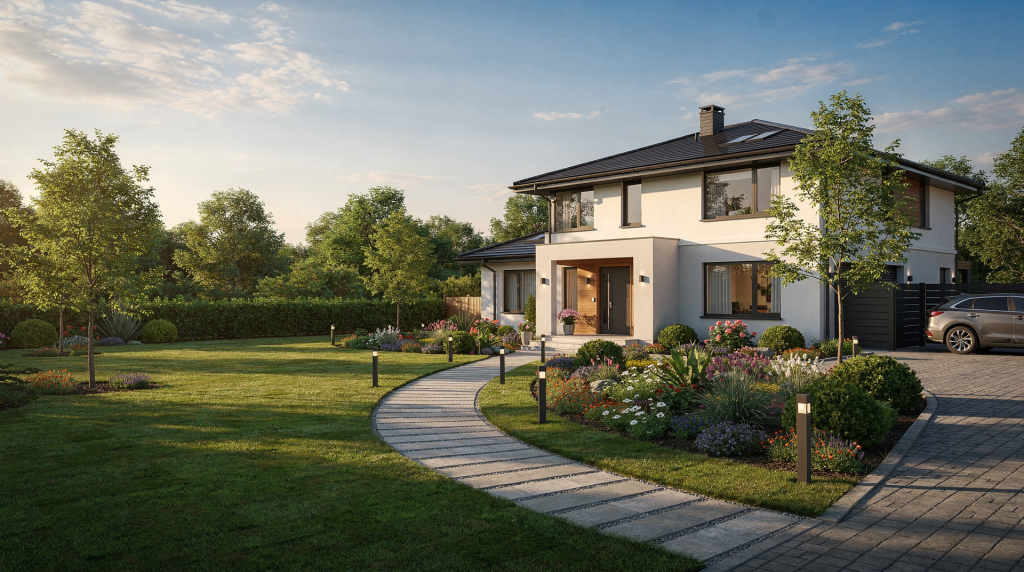
A well-designed outdoor space does far more than frame a house prettily from the street. Over years of photographing and writing about private gardens, I have watched the same pattern repeat itself: homes with coherent, usable landscapes sell faster, attract more viewings, and command figures that surprise their owners. In the current UK market, a thoughtfully composed garden can strengthen first impressions, improve saleability, and, in many cases, support a meaningful uplift in value.[1][2][8] The critical distinction lies not in simply “having a garden” but in creating a landscape that reads as intentional, functional, and straightforward to live with.
Why landscape matters to property value
Buyers process outdoor space on two tracks simultaneously: the emotional and the practical. Emotionally, a garden whispers promises of calm, privacy, and a slower rhythm of life—the scent of damp earth after rain, the sound of gravel underfoot, the filtered light through a canopy of leaves. Practically, it extends the home’s usable footprint, adding square-footage-like value by creating rooms without walls.[2][8] A terrace becomes a summer dining room; a quiet corner under a hornbeam becomes a reading nook; a generous lawn becomes a place for children to tumble.
In UK market coverage, estimates vary, but the direction remains consistent: well-presented gardens can add anywhere from single-digit percentages to around 20% in some cases, while larger outdoor space correlates with noticeably higher prices.[2][3][4][8] Savills has reported that buyers pay substantially more for homes with larger gardens, with a typical three-bedroom home with a large garden priced far above one with the smallest outdoor space.[8] I have stood in enough back gardens to know that numbers only tell part of the story—the real shift happens in how a buyer feels standing there, how quickly they can imagine Sunday mornings with coffee on the terrace or autumn afternoons gathering windfalls.
The takeaway is simple: landscape does not merely decorate a property. It changes how valuable the property feels to the buyer, and that feeling translates into decisions.
What actually adds value outdoors
Not every improvement carries the same weight. Some upgrades make a garden more desirable because they improve how the space functions day to day; others photograph beautifully but contribute little to resale. I have learned to distinguish between the two by asking one question: does this feature make the garden easier to inhabit, or merely more complicated to maintain?
Features that usually help
- Clear, usable zones for dining, sitting, play, or gardening—each with a distinct character but linked by a coherent material palette
- Strong connection between house and garden, where the threshold feels like a continuation rather than a boundary
- Good circulation and logical paths that guide movement naturally, without forcing awkward detours
- Healthy, established planting with year-round structure—evergreen bones holding the space together through winter
- Privacy from neighbours without feeling enclosed, achieved through layered planting rather than monolithic fencing
- Low-maintenance details that reduce buyer hesitation: self-binding gravel, robust perennials, simple clipped forms
- Lighting that extends use into the evening, picking out steps, paths, and the silhouette of a notable tree
- Well-kept boundaries, gates, and front approach that signal care from the first glance
Features that often disappoint
- Overly personal design choices that read as someone else’s obsession rather than a neutral canvas
- High-maintenance planting without structural framework, leaving the garden bare and exposed from November to March
- Complicated water features or gimmicky additions that demand constant attention and specialist knowledge
- Expensive materials used without a coherent layout—beautiful stone laid in a pattern that fights the architecture
- Oversized lawns with no purpose, becoming a burden rather than an asset
- Front gardens blocked by clutter, poorly planned parking, or a jumble of bins and bikes
A good landscape is not the one with the most features. It is the one that makes the property easier to live in and easier to imagine owning—the one where a buyer exhales and thinks, I could belong here.
The best design principle: make the garden feel like part of the house
Outdoor space adds more value when it reads as an extension of the home rather than a separate entity. The garden should feel intentional from the back door, as if the architecture simply continues outward in a different material—stone giving way to gravel, timber floors transitioning to decking, interior sightlines pulling the eye through glazing into greenery beyond.
1. Create a clear threshold
The transition from inside to outside matters enormously. A terrace, patio, or deck directly outside the house gives the eye a place to land and gives occupants an immediate usable area.[4] Even a modest sitting terrace—wide enough for a table and two chairs—can make the house feel larger by borrowing outdoor space into the interior volume. I always look at how the threshold is detailed: is the paving level with the interior floor, creating a seamless flow? Does the material echo something inside, like the same stone used for a kitchen floor? These small moves make the connection feel deliberate.
2. Design in rooms, not empty space
One of the most effective residential landscape strategies—and one I have seen transform awkward plots—is dividing the garden into “rooms” with different functions. This approach works especially well on family homes and country properties, where buyers expect outdoor space to support several uses simultaneously.
| Garden zone | Purpose | Value effect |
|---|---|---|
| Terrace or patio | Dining and entertaining | Makes the garden immediately usable |
| Lawn | Open family space | Works well if proportionate and easy to maintain |
| Planting beds | Structure and softness | Improves year-round appearance |
| Screening | Privacy and enclosure | Reduces buyer concerns about overlooking |
| Secondary corner | Storage, potting, reading, or play | Makes the garden feel larger and more versatile |
Each room should have its own atmosphere—a sunny breakfast corner, a shaded bench under a crab apple, a hidden compost area screened by yew hedging—but they must feel connected by a consistent language of materials and planting.
3. Keep the layout legible
Buyers dislike confusion. A garden with no clear route, no focal points, and no obvious use can feel larger on paper but smaller in reality because the eye has nowhere to rest and the mind cannot parse the space. A legible layout should answer three questions within seconds of stepping outside:
- Where do I sit?
- Where do I walk?
- What do I look at?
If those answers are obvious—a paved dining area to the left, a gravel path curving toward a bench under a tree, a sightline terminating at a simple sculpture or a well-placed pot—the garden usually feels more valuable. It feels resolved.
High-impact upgrades with practical returns
Some improvements consistently perform well because they combine visual appeal with everyday usefulness. These are the moves I see adding genuine value across property types, from terraced city plots to sprawling country gardens.
Front garden and kerb appeal
The front of the property shapes first impressions before anyone steps inside. A neat frontage, healthy planting, clean hard landscaping, and a clear path to the door can all make the home feel better cared for—and better cared for translates to higher perceived value. For suburban and urban homes, this is often where a relatively modest budget has an outsized effect. I have watched simple interventions—replacing cracked concrete with clay pavers, adding two clipped box balls flanking the entrance, painting the gate—transform how a house reads from the street.
Terrace, patio, or outdoor dining area
A defined seating area close to the house is one of the clearest value-additions. It creates an immediate lifestyle image: breakfast outside on warm mornings, summer entertaining as dusk falls, children playing nearby while adults linger at the table. This is why well-planned hard landscaping often performs better than decorative planting alone.[4] The material matters too: natural stone weathers gracefully, developing a patina that feels settled rather than tired; porcelain can work but risks looking sterile if not balanced by planting; timber decking needs honest maintenance but offers warmth underfoot.
Mature, balanced planting
A garden with structure looks established even when the planting is not expensive. Use a mix of evergreen framework—yew, box, holly, osmanthus—with seasonal interest layered in: spring bulbs, summer perennials, autumn grasses, winter stems. Repeat plant groups rather than scattering individual specimens; repetition creates rhythm and makes the space feel designed rather than collected.
Good planting should do three things:
- Frame the house, anchoring it to its site
- Soften hard edges—walls, fences, paving joints
- Keep the garden attractive outside peak season, so a November viewing still feels inviting
Privacy without heaviness
Buyers want seclusion, but they do not want to feel boxed in. Hedges—beech, hornbeam, yew—create living walls that breathe and change with the seasons. Layered planting, slatted screens, and well-placed trees often work better than tall solid fencing, which can feel oppressive and cast deep shade. I often recommend a combination: a hedge for year-round screening, underplanted with shade-tolerant perennials, with a small tree—a silver birch or a flowering cherry—lifting the canopy and letting light through.
Lighting
Subtle garden lighting improves safety, usability, and atmosphere. The best lighting is quiet and functional: steps picked out with low-level LEDs, a path washed with soft light, the edge of a terrace defined, a notable tree uplit to create drama after dark. Avoid over-lighting; a garden should not feel like a car park. The goal is to extend the garden’s useful hours gently, making it feel magical rather than municipal.
What to spend money on first
If the goal is to improve value rather than create a personal show garden, spend in this order:
- Fix access and circulation—paths that drain properly, steps that feel safe, routes that make sense
- Clean up boundaries, paths, and surfaces—repairing, painting, pressure-washing
- Create one strong terrace or seating area close to the house
- Improve front-of-house presentation
- Add structure with planting—evergreens first, then seasonal layers
- Introduce lighting
- Add secondary features only if they support the layout
This sequence prevents overspending on details before the fundamentals are right. I have seen too many gardens with expensive sculptures and neglected drainage, with elaborate water features and collapsing retaining walls. Get the bones right first.
How to judge whether a garden improvement is worth it
Use a simple test before committing to work. I run through this mentally on every project I document.
The three-part value check
- Will it make the property easier to use?
- Will it make the property easier to maintain?
- Will it help a buyer imagine living here?
If the answer is yes to all three, the investment is usually sensible. If it only satisfies one, reconsider.
Ask these practical questions
- Does the garden suit the property’s size and style, or does it feel borrowed from a different house?
- Is the design appropriate for the likely buyer—a young family, a downsizing couple, a weekend retreat seeker?
- Will the materials still look good in five years, or will they date quickly?
- Does this feature solve a real problem—poor privacy, awkward levels, lack of shelter—or is it purely decorative?
- Would the garden still feel attractive in winter, when the structure is exposed and the planting is dormant?
If a feature looks good only in one season or appeals to a narrow taste, it may not help resale as much as expected. Restraint is often the wiser investment.
Common mistakes that reduce value
Even expensive landscaping can undermine value if it works against the house. These are the errors I encounter most frequently.
1. Overdesigning the space
Too many materials, levels, or features can make a garden feel fragmented and restless. Buyers usually prefer calm, readable layouts where the eye can settle. A single, well-chosen paving material used consistently often reads as more sophisticated than three different stones competing for attention.
2. Ignoring maintenance
A garden that looks difficult to manage can scare off buyers. Heavy pruning regimes, water-intensive planting, or specialist upkeep—formal topiary, delicate exotics, large ponds—can reduce appeal. Most buyers want a garden that supports their life, not one that demands a second career.
3. Using the wrong style for the property
A formal parterre may suit a Georgian rectory but feels forced on a contemporary rural property with clean lines and large glazing. The garden should support the architecture, not fight it. I always look at the house first: its materials, its proportions, its relationship to the land. The garden should feel like an inevitable extension of that language.
4. Leaving the garden unfinished
Bare soil, temporary fencing, and weak boundaries make the whole property feel unresolved. Completion matters—even if the planting is young, the structure should feel settled. Mulch bare soil, define edges clearly, and ensure boundaries are robust.
5. Prioritising novelty over usability
Large ornaments, elaborate water features, and unusual paving can be memorable, but not always in a good way. Resale usually rewards restraint. A simple stone bench under a tree often adds more value than a dramatic sculpture that divides opinion.
A practical plan for different property types
For urban homes
- Maximise every square metre—every corner should earn its place
- Prioritise privacy and seating; in tight spaces, a single well-placed bench can transform a courtyard
- Use vertical planting where space is tight—climbers on walls, espaliered fruit trees, tall narrow evergreens
- Keep materials simple and durable: clay pavers, sawn stone, weathered timber
- Make the garden feel bigger with clear lines and, where appropriate, a well-positioned mirror or reflective surface—but use this trick sparingly
For family homes
- Create visible zones for adults and children, so supervision is easy from the house
- Keep lawn areas proportionate—large enough for play but not so vast they become a chore
- Add storage discreetly: a timber shed tucked behind hedging, a bin store integrated into fencing
- Use robust surfaces and planting that can withstand footballs and trampling
- Make the terrace wide enough for a table that seats everyone, with space to move around it
For country houses and larger plots
- Respect the setting and approach—the garden should feel like it belongs in its landscape, not imposed upon it
- Use planting to connect house and wider land: repeat native species, echo hedgerow patterns, let the garden soften at its edges
- Create destination areas—a wildflower meadow, a woodland walk, a kitchen garden—rather than one oversized lawn
- Balance open views with enclosure; long sightlines are wonderful, but people also need sheltered, intimate spaces
- Avoid making the garden feel over-managed; a country garden should have a little looseness, a sense that nature is a partner, not a subordinate
A homeowner’s checklist before selling
- Paths and access are clean and intact—no cracked pavers, no slippery moss
- Front garden looks tidy from the street—planting trimmed, bins hidden, gate painted
- There is at least one clear outdoor living area, furnished simply to suggest use
- Boundaries feel private but not oppressive—hedges trimmed, fences in good repair
- Planting is healthy and structured—dead plants removed, bare patches mulched
- The garden looks good from inside the house—sightlines through windows are clear and attractive
- Storage, bins, and tools are hidden from view
- Lighting and drainage are functioning—no puddles, no dark dead zones
- The space feels easy to understand quickly, so a buyer walking out the back door immediately grasps how to use it
When professional design is worth it
Professional help is most useful when the garden has one of these problems:
- Poor connection to the house—the back door opens onto an awkward level change or a blank wall
- Strange levels or awkward slopes that make the space feel unusable
- Weak privacy, where overlooking is a constant tension
- A large but underused plot that feels empty and purposeless
- A property where outdoor presentation will strongly affect sale price—perhaps a period house where the garden should match the architecture’s pedigree
In those cases, landscape design is not a cosmetic extra. It is a property strategy. A good designer reads the site, the architecture, and the likely buyer, then creates a framework that makes the garden feel inevitable—as if it could never have been any other way.
Conclusion
Outdoor space influences value because it affects how a home feels, functions, and photographs. In the UK market, well-designed gardens can make a property more desirable and, in the right context, significantly more valuable.[2][8] The strongest results come from clear layout, good access, privacy, durable materials, and planting that suits both the house and the likely buyer.
If the garden helps the property feel complete, usable, and easy to maintain, it is doing more than looking good. It is working as part of the home—an outdoor room that happens to have a sky for a ceiling and planting for walls. That is the kind of space buyers remember, and the kind they pay to own.
FAQ
Does landscaping always increase property value?
No. Poorly planned or highly specialised landscaping can limit appeal. Value rises most when the garden improves usability, presentation, and maintenance—making the property easier to live in and easier to imagine owning.
What garden improvements give the best return?
Usually a usable terrace, tidy boundaries, improved front-of-house presentation, and coherent planting. These features influence first impressions and daily function, which are the two factors that drive buyer decisions.
Is a low-maintenance garden better for resale?
Often yes. Many buyers want outdoor space without heavy upkeep, especially in urban and family-home markets. A garden that offers structure and beauty without demanding constant intervention tends to attract more interest.
Do large gardens always add value?
Not automatically. Size helps, but only if the space is practical, attractive, and well maintained. A large neglected garden can deter buyers who see it as a burden rather than an asset.
Should the garden match the architecture?
Yes. A garden that suits the house feels more convincing, and that coherence usually strengthens perceived value. The best gardens feel like an extension of the architectural language, not a separate statement.